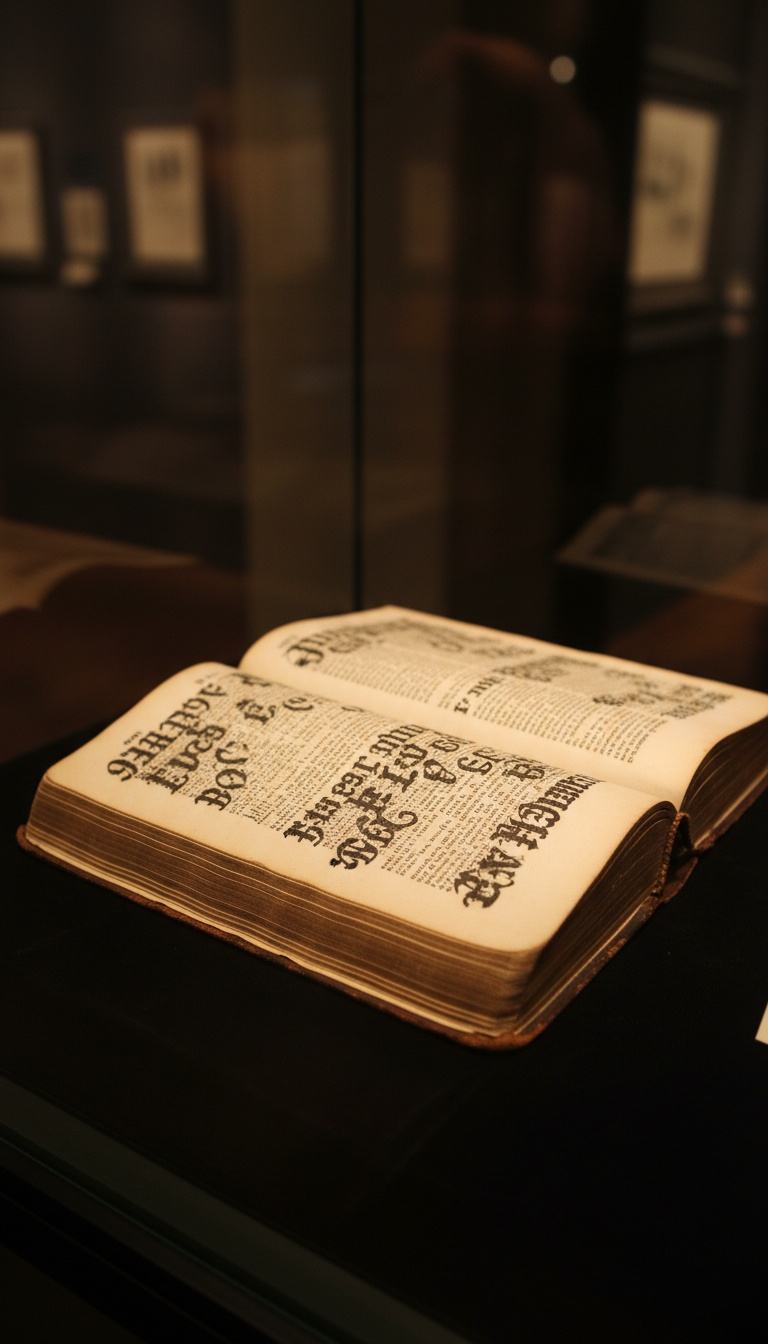
The Wicked Bible is a 1631 King James Bible, printed in London by the King's own printers Robert Barker and Martin Lucas, in which the Seventh Commandment at Exodus 20:14 reads "Thou shalt commit adultery." The Crown dragged both printers before the Star Chamber, fined them £300, stripped Barker of his royal printing licence, and ordered the whole print run seized and destroyed. A handful of copies escaped, and they sit today in some of the most guarded rare book rooms on earth.
History books call this a typo and move on. The punishment says otherwise. A slip of the type costs a printer one corrected page. This one cost the King's own printers a fortune, their monopoly, and every copy they had made. The Crown treated that missing word as an attack, so it was an attack.
The Page That Ordered a Sin
The book came off the press in London in 1631. It was a standard King James Bible, the authorized text, from the shop that held the royal patent to print it.
Turn to Exodus chapter 20, verse 14. The word "not" is gone. The line reads, in clean black letter type, "Thou shalt commit adultery." The one commandment about the marriage bed had been turned into an order.
That was one of two wounds. In Deuteronomy 5:24, where Moses tells Israel that God has shown them "his glory and his greatness," the Wicked Bible reads "his glory and his great asse." Two strikes at the dignity of God, in one edition, from one shop.
One error is an accident. Two errors aimed at the holiest passages in the book are a pattern. Both hit the Law of Moses, the section every reader in Caroline England knew by heart.
The Men Who Could Not Afford a Mistake
Robert Barker was the son of Christopher Barker, printer to Queen Elizabeth. The family held the patent as King's Printer, which meant the exclusive right to print the English Bible. Every authorized Bible in the realm came through their shop.
Barker's press printed the first edition of the King James Bible in 1611. Twenty years later his shop had set that text over and over. The compositors knew the Ten Commandments the way a farmer knows his own fence line.
Barker was also drowning in debt and fighting a long legal war. His rival, the printer Bonham Norton, had spent years in the courts trying to seize a share of the royal patent. The Bible monopoly was the most valuable printing right in England, and Barker had enemies inside his own trade who wanted it.
When the Wicked Bible hit the shops, it handed his rivals the one weapon they needed. A King's Printer who printed blasphemy was a King's Printer who could be removed.
The Crown's Response Was a Prosecution
The error surfaced about a year after printing, once copies were already sold and in circulation. King Charles I was told. George Abbot, Archbishop of Canterbury, was told. The matter went to the Star Chamber, the royal court that sat without a jury and answered to the King.
The Star Chamber fined Barker and Lucas £300. In 1631 that was a fortune, years of wages for a skilled tradesman, worth tens of thousands of pounds in modern money. Barker's printing licence was revoked.
Then the Crown went after the books themselves. Every copy that could be found was called in and destroyed. The order covered the entire run, which means officials went shop to shop and house to house collecting Bibles.
William Laud, then Bishop of London and soon Archbishop of Canterbury, used the case to rage against the state of English printing. He complained that the trade had sunk to boy compositors and unlearned correctors, where Bible printing had once been done by grave and learned men. The Church wanted everyone to see a lesson.
A typo costs a corrected page. This one cost a fortune, a royal licence, and every copy in England.
Why the Typo Story Breaks
The standard line is that a compositor dropped one small word and nobody caught it. That line collapses the moment you put the facts next to the punishment.
| Question | The "careless typo" reading | Our reading |
|---|---|---|
| Who set the page? | A tired workman | The royal shop that printed the 1611 original and had set this text for 20 years |
| Which verses broke? | Random lines | Exodus 20:14 and Deuteronomy 5:24, both in the Law of Moses, both insulting God |
| What does a printer do with an error? | Paste in a corrected leaf | The Crown skipped the fix and burned the whole run |
| What did it cost? | A reprint | £300, the royal licence, and the stock |
| Who gained? | Nobody | Every rival who wanted the Bible patent |
Printers in the 1600s fixed mistakes all the time. They used cancel leaves, a reprinted page glued in place of the bad one. The trade did it routinely, and the Crown could have ordered it here in a week.
The Crown chose destruction. You burn a book when its existence is the problem, and you correct it when the text is the problem. They burned this one.
The Rival in the Shadows
Researchers who have studied the Barker feud have raised the obvious question. Bonham Norton and his allies had spent years fighting Barker for the patent. A single word pulled from the composing stick would hand them the scandal they could never win in court.
A compositor could be bought for the price of a month's wages. The forme for Exodus 20 sat in an open shop for anyone with access to lift one word and walk away. The second hit in Deuteronomy shows the same hand testing how far it could go.
Barker never recovered. He spent his last years in debt and died in the King's Bench debtors' prison in 1645. The shop that printed the King James Bible ended with its owner in a cell.
That is the shape of a sabotage that worked. The target lost everything, the Crown destroyed the evidence, and the court record names only the victim.
Where the Survivors Sit
A small number of Wicked Bibles escaped the round-up. They are some of the rarest Bibles in the English language, and they are held behind glass in serious institutions.
Copies are held at the British Library in London, the New York Public Library, and Cambridge University Library. Others sit in the Dunham Bible Museum in Houston and the Museum of the Bible in Washington, D.C. When one reaches auction, it sells for five and six figures.
Every one of those survivors is a piece of evidence the Crown tried to erase. We track books that powerful hands tried to destroy in the lost books collection and in the Vault, and the Wicked Bible belongs on that shelf.
Look at what the record actually holds. It has the printers' names, the fine, the licence, the burning. It never names the hand that lifted the word, and nobody in the Star Chamber seems to have asked.
Someone wanted that word gone from God's law. Then someone wanted every copy gone from England. If those were two different people, who were they working for? And if they were the same person, why did the Crown let them walk away?
Frequently Asked
What is the Wicked Bible?
The Wicked Bible is a King James Bible printed in London in 1631 by royal printers Robert Barker and Martin Lucas. Its Seventh Commandment reads "Thou shalt commit adultery" because the word "not" was removed from Exodus 20:14.
What happened to the printers of the Wicked Bible?
The Star Chamber fined Barker and Lucas £300, a fortune in 1631, and Barker lost his royal printing licence. Barker later died in a debtors' prison in 1645.
How many Wicked Bibles still exist?
Only a small number survived the Crown's order to destroy the run. Known copies sit in the British Library, the New York Public Library, Cambridge University Library, the Dunham Bible Museum in Houston and the Museum of the Bible in Washington, D.C.
Was the Wicked Bible sabotage?
The evidence points that way. Barker's rival Bonham Norton was fighting him for the royal Bible patent, two separate insults to God appeared in the same edition, and the Crown burned the whole run where one corrected page would have fixed a real accident.
What was the second error in the Wicked Bible?
Deuteronomy 5:24 reads that God showed Israel "his glory and his great asse" where it should say "his greatness." Two attacks on the Law of Moses in one edition is a pattern.
Before you go
7 books the Vatican doesn't want you reading. Free PDF. The texts they cut, with sources. Joined by 300+ Inner Circle members.
No spam. Unsubscribe anytime.
Go deeper
The Hidden Canon, Vol. I: Enoch. Jubilees. Thomas. Mary. Judas. 90 pages, 14 chapters, every receipt cited. The books your Bible quietly removed.
Read the Canon →