Every major civilization on Earth wrote down the same flood, and it follows the same outline every time. A god warns one man. He builds a sealed vessel. He saves his family, and water covers everything. Sumer called him Ziusudra. Babylon called him Utnapishtim. Israel called him Noah, India called him Manu, and Greece called him Deucalion. Only one thing got filed under myth, and it was the flood itself.
That filing system is the trick. Textbooks put Noah on the religion shelf and every other flood on the folklore shelf, so no single shelf ever holds all of them at once. Lay them on one table and they stop reading like stories. They read like witness statements from people who never met, all describing the same night.
The Oldest Copy Sits in Philadelphia
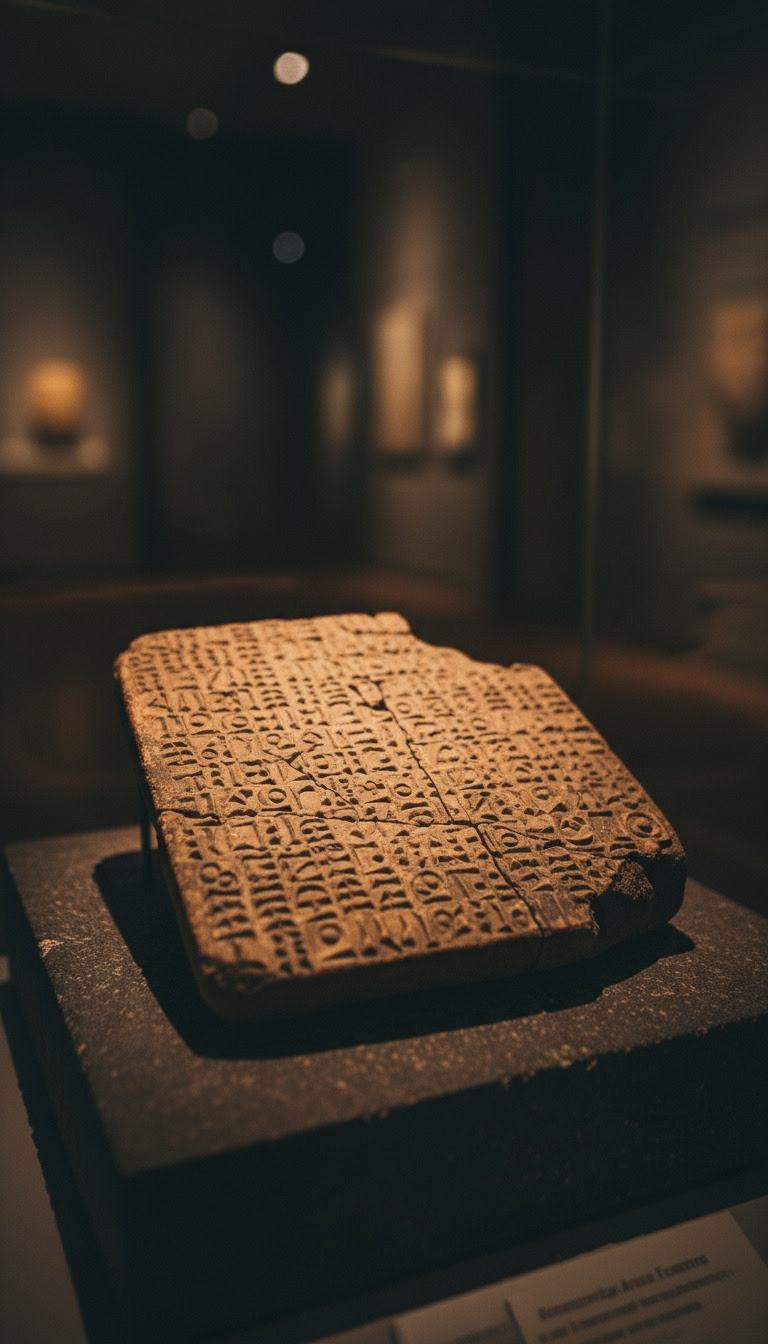
The earliest written flood is Sumerian, and it is older than Genesis by more than a thousand years. A clay tablet excavated at Nippur, catalogued as CBS 10673 at the Penn Museum in Philadelphia and dated to around 1600 BCE, tells how the god Enki speaks through a wall to Ziusudra, king of Shuruppak. Ziusudra builds a huge boat. The storm runs seven days and seven nights. When it clears, he opens a window and the sun comes in.
Modern scholars file Ziusudra as a character in a tale. The Sumerians filed him as a king. A copy of the Sumerian King List in the Ashmolean Museum in Oxford names him as the last ruler of Shuruppak before the line "then the flood swept over." The Babylonian priest Berossus repeated the same man as Xisuthros in the third century BCE. That makes three records across fourteen hundred years, and all three treat him as a man who ruled a real city.
Tablet Eleven Made a Museum Assistant Tear Off His Clothes
In 1872 George Smith, a self-taught assistant at the British Museum, was sorting tablets from the library of the Assyrian king Ashurbanipal at Nineveh. He read a fragment now catalogued as K.3375, the eleventh tablet of the Epic of Gilgamesh, and found a ship resting on a mountain and a bird sent out to look for dry land. Smith leapt up and began pulling off his clothes, a scene E. A. Wallis Budge later set down in the museum's own history. On 3 December 1872 Smith read the tablet to the Society of Biblical Archaeology, with Prime Minister William Gladstone in the audience.
The match with Genesis runs line for line. The god Ea warns Utnapishtim through a reed wall. Utnapishtim seals his boat with pitch, loads his family and the animals, and rides out the storm. The boat grounds on Mount Nimush, and he releases a dove, a swallow and a raven. Noah's ark grounds on the mountains of Ararat, and Noah releases a raven and a dove. Same warning, same pitch, same birds.
Assyriologists answered by declaring that Genesis borrowed from Babylon. That claim covers two neighbors on one river system and stops at the border. It cannot reach a fish in India, a chest in Greece, or a drowned race of wooden people in Guatemala. Babylon itself credited the story to an older Sumerian king. Every copy points further back, and the trail ends at an event.
A Fish in India, a Chest in Greece
India's version sits in the Shatapatha Brahmana, a Sanskrit ritual text from the first millennium BCE. Manu is washing his hands when a small fish swims into them and asks to be raised. In return it warns him that a flood is coming to carry away every living creature. Manu builds a ship, ties it to the fish's horn, and is towed to a northern mountain. The text names the slope where he came down Manu's Descent.
Greece's version is preserved in the Bibliotheca of Apollodorus and in Book One of Ovid's Metamorphoses. Zeus decides to drown the men of the Bronze Age. The Titan Prometheus warns his own son, Deucalion, who builds a chest, stocks it, and climbs in with his wife Pyrrha. They float nine days and nine nights and come to rest on Mount Parnassus. Afterward they throw stones over their shoulders, and the stones rise as a new people.
Five cultures. Five languages. One report.
| Source | Survivor | Who Warned Him | Vessel | Where It Ended |
|---|---|---|---|---|
| Eridu Genesis tablet, Penn Museum (c. 1600 BCE) | Ziusudra | Enki | Great boat | Sun returns after seven days |
| Gilgamesh Tablet XI, British Museum (7th century BCE copy) | Utnapishtim | Ea | Boat sealed with pitch | Mount Nimush |
| Genesis 6 to 9 | Noah | Yahweh | Ark sealed with pitch | Mountains of Ararat |
| Shatapatha Brahmana 1.8.1 | Manu | A fish | Ship towed by the fish | Northern mountain |
| Apollodorus, Bibliotheca 1.7.2 | Deucalion | Prometheus | Sealed chest | Mount Parnassus |
China Remembered the Cleanup
China's flood has no single boat because China recorded what came after the water. The Book of Documents says the flood rose over the hills and swamped the heavens. The engineer Gun spent nine years trying to dam it and failed. His son Yu spent thirteen years cutting channels and draining the land, and he passed his own front gate three times without going inside. Yu went on to found the Xia, China's first dynasty.
The receipt is cast in bronze. The Bin Gong Xu, a Western Zhou ritual vessel dated to around 900 BCE and held at the Poly Art Museum in Beijing, opens its inscription with Heaven commanding Yu to spread the soil, cut through the mountains and dredge the rivers. It is the oldest written mention of Yu, and it treats the flood as history.
A river floods every spring. A river does not pick one man, warn him in advance, and tell him to seal a boat.
The Americas and Australia Were Never in the Room
The K'iche' Maya kept their flood in their own book of creation. The Popol Vuh, preserved in the Francisco Ximénez manuscript at the Newberry Library in Chicago, says the gods made a race of wooden people who forgot their makers. A great flood came down on them, with a black rain falling day and night, and that world ended.
In the Andes, the creator Viracocha drowned a race of giants in a flood the Inca called unu pachakuti, the world overturned by water, and the survivors emerged at Lake Titicaca. Juan de Betanzos wrote the account down in the 1550s from Inca nobles in Cusco, a lineage that carried it long before any Spanish ship reached the coast.
Australia is the hardest receipt to wave away. In 2016 the linguist Nicholas Reid and the geographer Patrick Nunn published a study in Australian Geographer matching Aboriginal stories from 21 places around the coast to the drowning of the continental shelf. The stories describe coastlines that sit underwater today, and the sea-floor maps confirm them. Some of those memories run back more than 7,000 years. Missionaries did not carry bathymetric charts.
Rivers Do Not Send Warnings
The last defense on the textbook shelf is that rivers flood everywhere, so everyone wrote about a flood. The Euphrates floods. The Ganges floods. The Yellow River floods. A river flood explains wet fields. It cannot explain a warning delivered to one man before the water came, a vessel sealed against it, and a new human line started afterward on a mountain. That exact structure repeats on the Euphrates, on the Ganges and in Greece.
The ground holds an event big enough to match. At the end of the last Ice Age the oceans rose roughly 120 meters. Meltwater Pulse 1A, about 14,500 years ago, lifted the seas some 16 to 20 meters in a few centuries, and the Younger Dryas struck around 12,900 years ago. Whole coastlines where people lived went under. Our Canon traces how the Genesis editors handled the oldest of these memories, and the Lost Books collection covers what the Book of Enoch says about the Watchers and why the water was sent.
Strip out the names and every version answers to the same outline. Someone knew before the water came. Someone chose who would survive. Someone told them to seal the vessel and bring the animals. Sumer said Enki. Babylon said Ea. India said a fish with a horn. Greece said a Titan who had already been punished once for helping humans.
Five warners, one warning, carried by cultures that shared no language. The textbooks gave each of them a different shelf so nobody would ask the obvious question. Who was doing the warning, and why did they save only one family every time? Tell us which version you think is the original.
Frequently Asked
Did every ancient civilization have a flood story?
Yes. Sumer, Babylon, Israel, India, Greece, China, the Maya, the Inca and Aboriginal Australia all recorded a world-ending flood, and the oldest written versions share a warned survivor and a sealed vessel.
What is the oldest written flood story?
The Sumerian Eridu Genesis, on a tablet from Nippur held at the Penn Museum in Philadelphia, dated to around 1600 BCE. Its survivor, Ziusudra, also appears as a king in the Sumerian King List.
Was Noah's flood copied from the Epic of Gilgamesh?
Genesis and Tablet XI of Gilgamesh share the warning, the pitch-sealed boat, the mountain landing and the birds. Both point back to an older Sumerian king, which makes them two copies of one earlier record.
Where is the Gilgamesh flood tablet today?
Tablet XI, catalogued K.3375, is in the British Museum in London. It came from the library of the Assyrian king Ashurbanipal at Nineveh, and George Smith first read it there in 1872.
What real event could explain a worldwide flood memory?
The end of the last Ice Age raised global sea levels by roughly 120 meters, with Meltwater Pulse 1A adding 16 to 20 meters about 14,500 years ago. Aboriginal Australian stories still describe coastlines that drowned in that rise.
Before you go
7 books the Vatican doesn't want you reading. Free PDF. The texts they cut, with sources. Joined by 300+ Inner Circle members.
No spam. Unsubscribe anytime.
Go deeper
The Hidden Canon, Vol. I: Enoch. Jubilees. Thomas. Mary. Judas. 90 pages, 14 chapters, every receipt cited. The books your Bible quietly removed.
Read the Canon →