Two thousand years before Jesus of Nazareth was nailed to a Roman cross, Egyptian priests at Abydos were chiseling the same story into temple walls.
A god, killed by his enemies. His body broken into pieces. His mother and a sister-goddess gathering the fragments and restoring him. A descent into the underworld. A return. A judgment of the dead conducted by the resurrected one. Followers fed sacred bread that promised eternal life.
The god's name was Osiris. The earliest written version of his death-and-resurrection cycle dates to the Pyramid Texts of Unas, sealed in a royal tomb at Saqqara around 2350 BCE.
That is not a typo. Two thousand three hundred and fifty years before Christ.
The Pattern That Predates the Religion
The structural elements are not vague. They appear, in nearly identical sequence, across at least six pre-Christian religious traditions spanning three continents and three thousand years:
- A savior figure born of a divine father and a mortal or virginal mother
- A miraculous birth on or near the winter solstice
- A small inner circle of followers, typically twelve
- A ministry of teaching, healing, and overturning religious authority
- A sacred meal of bread and wine, offered as the god's body
- Betrayal, suffering, and a sacrificial death
- Descent into the underworld
- Resurrection on the third day
- Ascension and the promise of eternal life to followers who consume the sacred meal
This sequence, sometimes called the archetype of the dying and rising savior, is not a Christian invention. It is the shared inheritance of Bronze Age and Iron Age religion across the ancient Mediterranean and Near East.
The names changed. The story did not.
Mithras, Born From a Rock on December 25
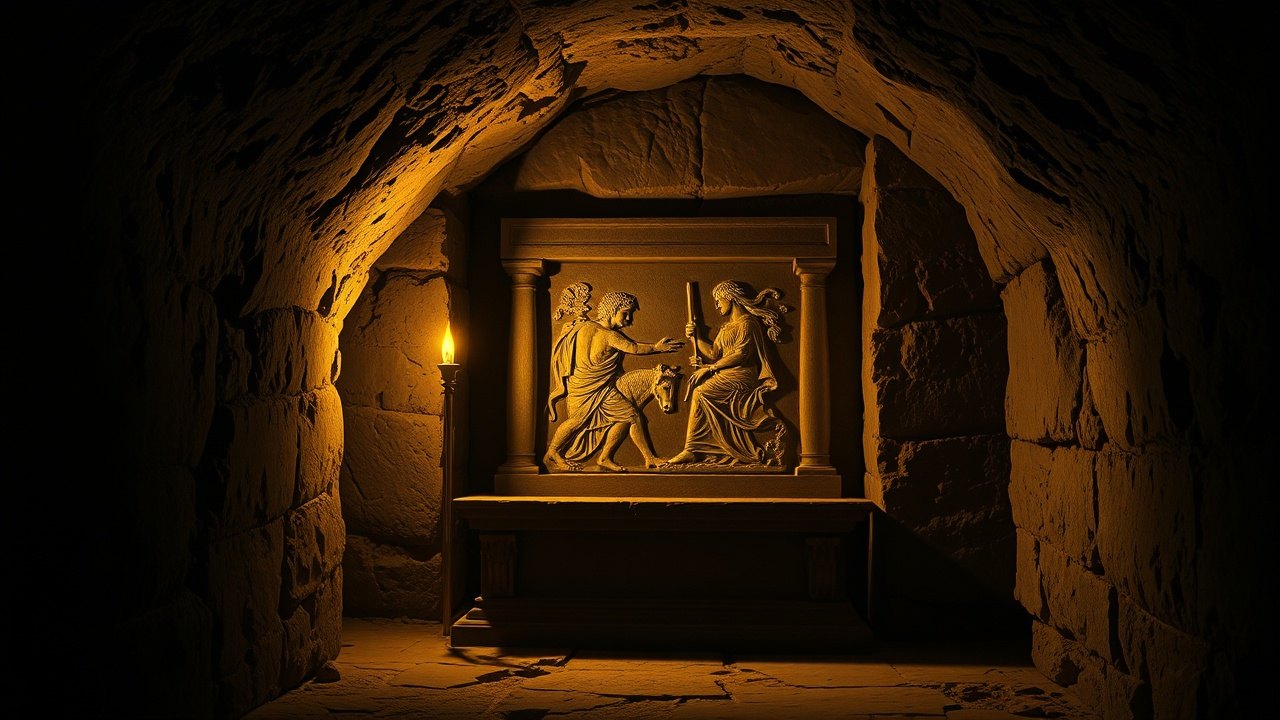
The Roman cult of Mithras was the most direct competitor to early Christianity in the first three centuries of the common era. By the year 200 CE, Mithraea, the underground temples of Mithras, had been carved into hillsides from Roman Britain to Syria. The cult was the unofficial religion of the Roman legions. Soldiers carried it from province to province. Emperors patronized it.
Mithras was born from a rock on December 25, attended by shepherds bearing gifts. He performed miracles. He shared a final sacred meal of bread and wine with twelve companions, declaring that those who consumed it would receive eternal life. He died, was buried in a tomb sealed by stone, and rose three days later. His followers were initiated by a ritual baptism that washed away sin.
None of this is contested by historians. The Mithraic mysteries are documented in surviving Mithraea, in Roman literature, and in the writings of early Christian polemicists. The only thing anyone still argues over is the direction of influence, and the calendar settles that without a debate: Mithras was already carved into hillsides from Britain to Syria while the Gospels were still unwritten. Mainstream comparative religion admits the parallels. It simply declines to say out loud which one came first.
Justin Martyr, a Christian apologist writing in the second century, addressed the parallels directly. His explanation: demons, knowing the future, had counterfeited Christian rites in advance to deceive humanity. He did not deny the resemblance. He explained it as preemptive demonic plagiarism.
"The cult of Mithras dominated the Roman Empire two centuries before Christianity arrived. Bread, wine, twelve followers, December 25, resurrection on the third day. Justin Martyr did not deny it. He blamed demons."
Osiris, Killed and Restored Two Thousand Years Earlier
Osiris is the older case. The Egyptian death-and-resurrection cycle is the foundation of Egyptian funerary religion. Every pharaoh, upon death, was identified with Osiris. The Book of the Dead, Egyptian funerary texts compiled from earlier sources, describes the deceased's hope of judgment by Osiris and rebirth into eternal life through identification with the resurrected god.
The narrative is preserved in fragmentary form across multiple sources, including the Pyramid Texts (c. 2400-2300 BCE), the Coffin Texts (c. 2100-1700 BCE), the writings of Plutarch (1st-2nd century CE), and surviving temple reliefs at Abydos, Philae, and Edfu.
Osiris is killed by his brother Set. His body is dismembered. His sister-wife Isis searches the world to recover the pieces and reassembles him through magical rites. Osiris is restored, not to ordinary life, but to a transformed existence as judge of the dead in the underworld. His son Horus avenges him and inherits the kingship of the living.
The Egyptian initiate, through funerary ritual, was identified with Osiris. The deceased's body was treated with sacred preparations meant to mirror what had been done to the god. The Egyptian phrase repeated in tombs from the Old Kingdom onward: "You have not gone away dead. You have gone away alive."
Two thousand years before any apostle wrote the Gospel of John.
Dionysus, the Bread-and-Wine God
The Greek mystery cult of Dionysus centered on a god born from the union of a mortal woman (Semele) and the supreme god (Zeus). His followers ritually consumed bread and wine in a sacrament that identified them with the god himself. The wine was Dionysus's blood. The bread was Dionysus's body.
He died, torn apart by Titans in some traditions, by maenads in others, and was reborn. Initiates into his mysteries underwent a ritual death and rebirth that promised them participation in his immortality.
The Dionysian mysteries were practiced from at least the 6th century BCE through the late Roman period. They were one of the most widespread mystery religions in the Mediterranean world during the lifetime of the historical Jesus.
If you were a Greek-speaking convert in 50 CE encountering Paul's description of a sacred meal where bread became the body of a god and wine became his blood, the resemblance to the Dionysian sacrament would have been immediate and obvious.
Attis, Resurrected on March 25
The Phrygian god Attis died and was resurrected. The annual festival of his death and return, the Hilaria, was celebrated in Rome on March 25, three days before Easter.
Attis was the consort of the mother-goddess Cybele. The narrative: Attis is wounded, dies under a pine tree, is mourned, and returns to life on the third day. His followers underwent a baptism in bull's blood, the taurobolium, believed to confer rebirth.
The cult of Attis and Cybele was officially imported into Rome in 204 BCE. By the time Christianity emerged, it had been a state-recognized religion for over two centuries. The annual cycle of Attis's death and resurrection was a fixed point on the Roman religious calendar.
The proximity of Hilaria to Easter is not coincidence. Both were spring festivals tied to the same archetype: the savior god dying as winter ends, returning as life returns to the earth.
Tammuz and the Older Memory
The Sumerian god Tammuz, known to the Babylonians as Dumuzi and to the Phoenicians as Adonis, is older still. The earliest Tammuz hymns date to roughly 2000 BCE. Tammuz dies in the heat of midsummer and is mourned by his consort Inanna; he returns in the spring.
The Hebrew Bible itself acknowledges this cult. Ezekiel 8:14, written during the Babylonian exile, describes Hebrew women weeping for Tammuz at the gate of the Jerusalem Temple. The prophet condemns the practice, but its presence inside the Temple's perimeter, even as a transgression, indicates how deeply embedded the dying-and-rising god archetype was in the religious environment of ancient Israel.