Mithras Was Baptized 200 Years Before Jesus. The Roman Legions Brought It.
By Jordan Vale·2026-05-14·8 min read
The Roman cult of Mithras reached the Italian peninsula sometime in the late second century BCE. By 100 BCE, a full century before the birth of the historical Jesus, Mithraic underground temples were being carved into the hillsides of Roman Italy. By 200 CE, they had spread along every major military road in the empire, from Hadrian's Wall to the Euphrates frontier.
One of the central rites of Mithraic initiation, attested in multiple independent sources, was a ritual bath in pure water that washed away the sins of the candidate's previous life and inducted them into the new community of the god.
The rite is described, in negative form, by the second-century Christian theologian Tertullian in his treatise De Baptismo, written around 200 CE. Tertullian's complaint was that the pagans of his day were performing a ritual that resembled Christian baptism too closely. His explanation, preserved in De Praescriptione Haereticorum Chapter 40: the devil had been imitating the Christian sacraments in advance to confuse the faithful.
The complaint contains an admission. Tertullian does not deny that the Mithraic rite existed. He does not deny that it functioned the way Christian baptism functioned. He attributes the resemblance to supernatural plagiarism, but he confirms, in writing, that the resemblance was real, was widespread, and was an embarrassment to his own community.
What the Roman Legions Carried East to West
Mithras was originally an Indo-Iranian deity: Mitra in the Vedic Sanskrit hymns, Mithra in the Persian Avesta. The Roman cult that emerged in the late Hellenistic period drew on Persian iconography and built its own ritual system on top of it, distinct enough from anything practiced in the Iranian-speaking world that scholars file the two as separate religions. Filing them separately does not unmake the inheritance. The name crossed the empire intact, and so did the water.
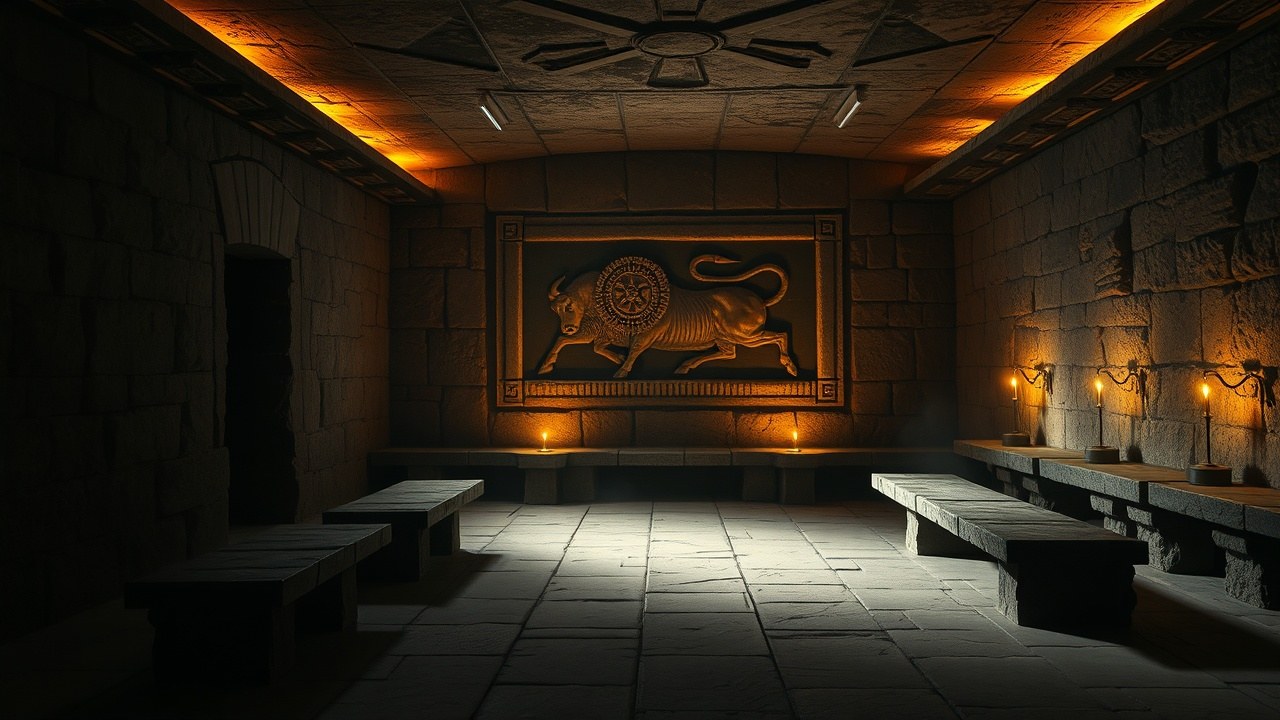
The Roman Mithras was a savior god. He was depicted slaying a sacred bull, the famous tauroctony scene preserved in dozens of surviving cult reliefs, with the bull's blood becoming a source of life and renewal for the world. Initiates passed through seven graded ranks (Corax, Nymphus, Miles, Leo, Perses, Heliodromus, Pater), each marked by a distinct ritual.
The first initiation was the ritual immersion. The detailed liturgy is reconstructed from a combination of cult-relief iconography, Latin and Greek inscriptions found at Mithraea, the fragmentary Mithras Liturgy preserved in the Greek magical papyri, and the polemical writings of Christian theologians who were close enough to the Mithraic communities to know how the rites were conducted.
The Mithraea Are Still Standing
Over four hundred Mithraea, Mithraic underground temples, have been excavated across the Roman world. The standard layout is consistent: a low rectangular hall with stone benches running along both long walls, a central aisle, an altar at the far end depicting the bull-slaying scene, and, significantly, a built water basin or fountain near the entrance, used for the purification of entering initiates.
The major surviving examples include:
The London Mithraeum, excavated 1954, now displayed at Bloomberg's London headquarters. Walbrook district, dated to roughly 240 CE
The Mithraeum of Santa Prisca, Rome, under the Church of Santa Prisca on the Aventine. Famously, the church was built directly on top of the suppressed Mithraeum
The Mithraeum of San Clemente, Rome, under the Basilica of San Clemente. Three levels of religious building stacked: 4th-century church, 1st-century Mithraeum, earlier Roman residence
Dura-Europos Mithraeum, Syria, sealed by Sassanid attack in 256 CE, preserved nearly intact
Carrawburgh Mithraeum, Hadrian's Wall, military Mithraeum serving the Roman garrison
These are not theoretical buildings. They are physical structures, with water installations still in situ. The Walbrook stream provided the water supply for the London Mithraeum's initiatory bath. The cisterns at Dura-Europos are visible in the published excavation reports.
🔒 Research Without Being Tracked
Reading suppressed history, ancient baptismal rites, pre-Christian mystery cults, Vatican-archive admissions, leaves digital fingerprints. The VPN we use at Hidden Epoch while researching these topics. First 3 months free.
Alongside the water rite, a second purification existed in the Mithraic system: the taurobolium, in which the initiate stood in a pit beneath a grated platform while a sacred bull was slaughtered above. The blood drenched the initiate. The mythology framed this as the believer being literally bathed in the saving blood of the cosmic bull whose death sustained the world.
This is the rite Tertullian attacks most directly. In Latin Christian polemic of the second and third centuries, the language of being "washed in the blood of the Lamb", the soteriological language of Pauline Christianity, is described as a doctrine the demons counterfeited in advance through the bull-blood baptism of Mithras.
The structural elements are difficult to dismiss as coincidence:
A god whose sacrificial death generates a substance (blood) that confers spiritual renewal
An initiation ritual in which the candidate is bathed in that substance, literally or symbolically
A formula declaring the initiate cleansed from prior sin and inducted into the saving community
A sacred meal of bread and a wine-mixture, taken in commemoration of the god's body and life
Justin Martyr, in First Apology 66, describes the Christian Eucharist and then immediately compares it to a Mithraic rite he knows personally: "This the wicked demons have imitated, commanding the same thing to be done in the mysteries of Mithras." He is not making this up. He is reporting it.
The Dating Question, Settled
The most common counter-argument, that the Mithraic rites of the second and third centuries CE may have borrowed from Christianity rather than the other way around, does not hold up against the archaeological dating.
The earliest Mithraic inscriptions in Italy date to the late first century BCE. The cult was already structured around initiation by water and a sacred meal of bread and wine well before the gospel of Mark was composed (c. 70 CE). The Roman writer Plutarch, writing around 100 CE, refers to the Mithraic rites as having been brought to Italy by Cilician pirates after Pompey's campaign in 67 BCE, over a century before Christianity arrived in Rome.
By the time Paul wrote his letter to the Romans in roughly 57 CE, the Mithraic mystery was a fixture of Roman religious life. The communities Paul was writing to would have known what a Mithraic initiation looked like. The terminology Paul deploys, baptisma, communion in the death of a god, washing of regeneration, was not landing in a culture without precedent. It was landing in a culture that already had three or four different versions of the same idea.
What the Suppression Looked Like
The Mithraic mystery survived the imperial conversion to Christianity by less than a generation. Constantine's tolerance edicts of 313 CE protected non-Christian cults legally, but the social pressure shifted rapidly. By the late fourth century, under Theodosius I (379-395 CE), pagan religious practice was actively criminalized. The Mithraea were systematically destroyed or converted.
Two of the most important Roman Mithraea were not just destroyed but architecturally inverted: the Mithraeum at Santa Prisca and the Mithraeum at San Clemente both had Christian basilicas built directly on top of them. The Mithraeum was sealed off and a church floor was poured above. The same physical location continued to function as a religious site. The deity worshipped at that site changed.
This is documented in the architectural stratigraphy of both churches, both of which are open to the public today. You can pay an admission fee, descend through the basilica floor, and walk through the Mithraeum that was buried to make room for Christianity. The bull-slaying relief is still in place at San Clemente.
The Argument the Church Used
From Justin Martyr in the mid-second century through Tertullian in the early third and Augustine in the fifth, the patristic response to the obvious Mithras parallels was consistent: the resemblance is real, but the priority is reversed. The demons knew, through prophecy, that Christ would come. They counterfeited his rites in advance through the Mithraic mysteries to confuse the world and to draw souls into idolatry.
That argument is a tacit concession. It accepts that the parallels exist. It accepts that they are close enough to require explanation. It only contests the direction of influence, and even then, it does so through an appeal to demonic foreknowledge that no modern Catholic, Orthodox, or Protestant theologian would defend on its original terms.
Modern scholarship kept the shape of that argument and swapped out the demons for a softer word. For over a century, mainstream comparative-religion scholarship has taught that the religious world of the late Hellenistic and early Roman period was a cross-pollinating ecosystem of mystery cults sharing structural features: Mithras drawing from Iranian and Hellenistic sources, Christianity drawing from Second Temple Judaism, the Pauline reframing of the Christ event, and the broader Hellenistic mystery-religion idiom, with the shared features written off as products of a shared cultural environment.
Look at what that explanation actually does. It concedes every parallel Tertullian conceded, then dissolves the transmission into weather. A cultural environment does not cut a water basin into the entrance of four hundred temples. It does not grade seven initiations in a fixed order. It does not set bread and a wine-mixture on the altar and attach them to the death of a god. Rites travel the way everything else travels in an empire: by hands, by roads, by priesthoods. Rome supplied all three, and the legions carried the cult to every frontier before a single gospel was written.
Justin Martyr and Tertullian stood close enough to the Mithraea to smell the smoke, and both of them named the direction of borrowing correctly. The parallels were real, the older rite came first, and the newer one grew inside it. The fathers got the culprit wrong. It was never the demons. It was Mithras.
The Architectural Lineage Is Hard to Argue With
Sumerian baptism in the Abzu at Eridu, 2300 BCE. Israelite ritual immersion at the Temple's bronze laver and at the post-exilic mikveh, 600 BCE onward. Mithraic baptism in the Roman Mithraea, 100 BCE through 380 CE. Christian baptism in the basilical baptistery, 200 CE through the present.
Same architectural form. Same ritual function. Same theological frame: water marks the boundary between the old self and the new, between the unclean and the sacred.
The Roman legions did not invent this. They inherited it from the Persian Mithra cult, which inherited it from the broader West Asian temple tradition, which inherited it ultimately from the Sumerian Abzu rite at Eridu.
The Christians did not invent it either. They inherited it from John the Baptist, who inherited it from the Second Temple tradition, which inherited it from the same Mesopotamian root.
The rite is older than the religion that owns it. The Mithraea are still standing as evidence. The basilicas built on top of them are not erasure, they are confirmation that the site, the act, and the meaning continued. Only the name changed.
Related Investigation
JV
Jordan ValeInvestigative Writer, Hidden Epoch
Jordan Vale is an independent historian and investigative writer specializing in suppressed archaeology, biblical history, and ancient anomalies. He writes to make the buried past impossible to ignore.