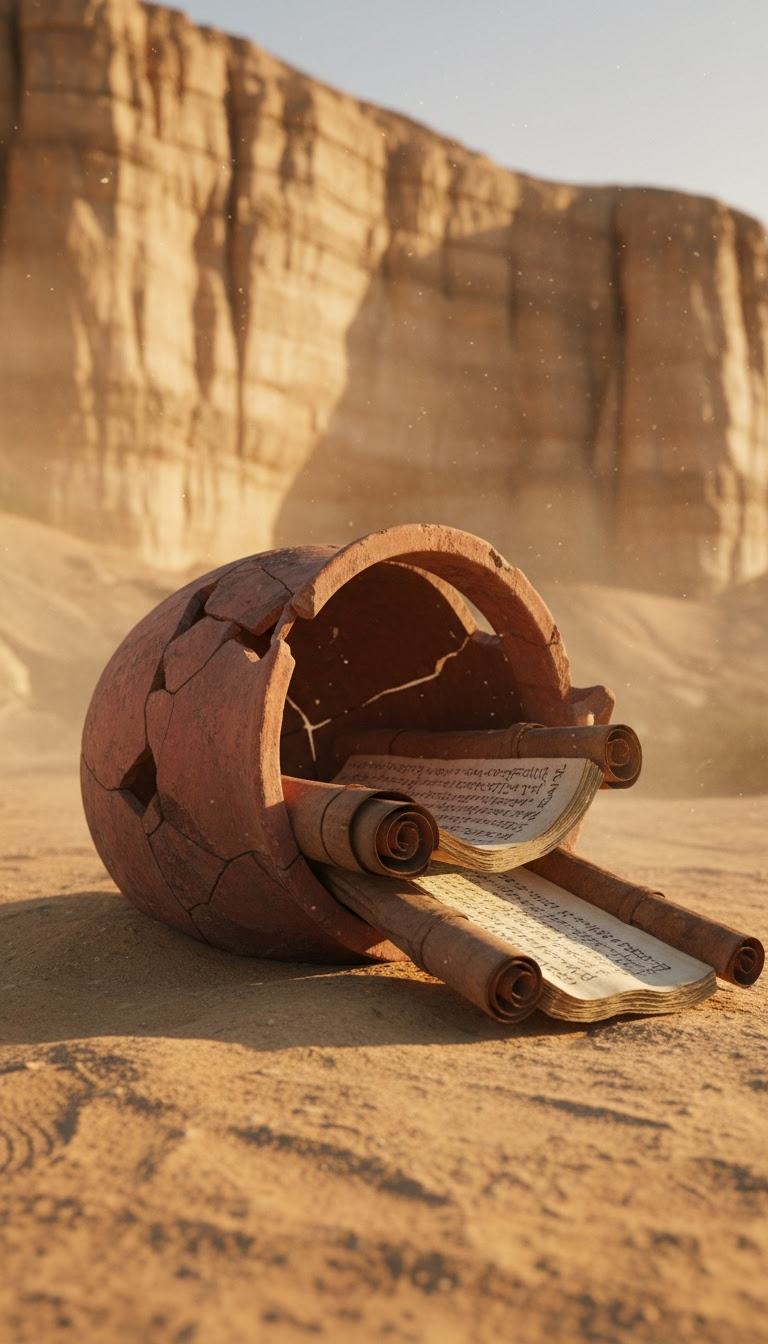
Fifty-two secret texts were sealed in a clay jar and buried under the Jabal al-Tarif cliff near Nag Hammadi, Egypt, after Bishop Athanasius of Alexandria ordered every church in Egypt in 367 AD to accept only twenty-seven books and branded the rest the inventions of heretics. Monks living a few miles away in the Pachomian monasteries hid thirteen leather-bound Coptic books instead of handing them over. The jar stayed shut for sixteen centuries, until a farmer broke it open in December 1945.
The books survived. The Christ inside them survived too. Today all thirteen codices sit in the Coptic Museum in Cairo. They hold a Jesus who speaks in riddles, finds the kingdom inside you, and needs no bishop to reach you. That is the Jesus the twenty-seven-book Bible was built to leave out.
The Easter Letter That Closed the Bible
Every year the bishop of Alexandria sent a Festal Letter to the churches of Egypt announcing the date of Easter. In 367 AD, Athanasius used his thirty-ninth letter to do something no bishop had done before. He listed exactly twenty-seven books for the New Testament. It is the same twenty-seven you will find in any church pew today.
Then he locked the door. "Let no man add to these, neither let him take ought from these." Every other book circulating among Egypt's Christians, he wrote, was an invention of heretics, written whenever they pleased and dressed up with ancient dates to fool the simple.
Look at the three receipts. A fixed date, Easter 367. A fixed number, twenty-seven. A fixed penalty, the heretic label on everything left over. That letter did more than describe the Bible. It created one, and it made everything outside it illegal to own.
The Order Reached the Monasteries on the Nile
Athanasius wrote in Greek. The monks of Upper Egypt read Coptic. So the letter was translated. The Bohairic Life of Pachomius records that Theodore, who led the Pachomian monasteries after their founder died, had the Easter letter put into Coptic and set down as a rule for his houses.
Those houses stood right beside the cliff. Pbow, the headquarters of the Pachomian federation, lay a few miles from Jabal al-Tarif. Chenoboskion, where Pachomius himself was baptized, sat across the same stretch of river. The bishop's order and the buried jar share one valley.
Every monk in those monasteries now had the same choice. Hand the books over, or make them disappear. Somebody chose the second option, and chose it carefully.
You do not seal a jar against the damp to throw something away. You seal it to come back for it.
Thirteen Books, One Jar, and a Cliff
What came out of the jar in 1945 was a library. Thirteen codices, papyrus pages sewn into leather covers, written entirely in Coptic. Together they carry fifty-two separate texts. Three of them are copies of the same book, the Apocryphon of John. A library that keeps three copies of one forbidden text is a library that expects readers.
The covers give the date away. Their leather was stiffened with scrap papyrus, and that scrap includes dated receipts and letters from the 340s, the latest from 348 AD. The books were bound after 348. The ban landed in 367. The binding, the ban, and the burial all fall inside one generation of monks.
The jar was buried under a boulder at the foot of the cliff. It sat dry and dark, below caves that were already ancient tombs. That is a hiding place picked by someone who knew the ground and planned to return.
| What Athanasius allowed in 367 | What the Nag Hammadi jar kept | |
|---|---|---|
| Number of books | Twenty-seven, closed forever | Fifty-two texts in thirteen codices |
| Language | Greek letter, Coptic copy for the monks | Coptic on every page |
| Who Jesus is | A Savior known through the bishops | A "living Jesus" whose secret sayings save whoever understands them |
| Where the kingdom is | Coming at the end of time | "Inside you, and it is outside you" (Gospel of Thomas, saying 3) |
| Fate of the rest | Branded the invention of heretics | Sealed in clay and buried for 1,600 years |
December 1945: The Farmer and the Fertilizer
Muhammad Ali al-Samman was digging for sabakh, the nitrate-rich soil Egyptian farmers spread on their fields. His mattock hit the jar under the boulder. He hesitated to break it, afraid of a jinn. He broke it anyway, hoping for gold.
He found books. By his own later account, his mother fed some loose pages into the bread oven. The rest went out through the antiquities trade in Cairo, where the Coptic Museum seized and bought what it could reach.
One codex escaped the country entirely. Codex I was smuggled abroad, bought in 1952 for the C.G. Jung Institute in Zurich, and renamed the Jung Codex. It returned to Cairo in stages over the following years. The full library was not published in English until 1977. Thirty-two years passed between the jar breaking and the public reading a single complete page.
The Christ the New Bible Had No Room For
The Gospel of Thomas opens the door. It holds 114 sayings of Jesus with no birth, no miracles, and no crucifixion. "Whoever finds the interpretation of these sayings will not taste death." Salvation comes from understanding, and it needs no bishop to hand it out.
Saying 77 goes further. "Split a piece of wood, and I am there. Lift up the stone, and you will find me there." A Christ found under any stone is a Christ no institution can own. That one line threatens every church built to stand between you and him.
The Gospel of Philip calls Mary Magdalene the companion of Jesus. The Apocryphon of John retells Genesis with a false god ruling this world. The Gospel of Truth calls ignorance the real fall. Three books, three doors the twenty-seven-book Bible bolted shut.
Some scholars call the jar a grave deposit, books buried with a dead monk. The jar itself breaks that idea. Grave goods go in a grave. This library went into a sealed vessel under a marked boulder, three copies deep, in the same decade Theodore read the ban aloud to his monks. A man burying his dead does not hide a library. A man defending one does.
One jar came out of that cliff. One farmer, one mattock, one lucky December. The Pachomian federation ran nine monasteries along that stretch of the Nile, and every one of them received the same Coptic copy of the same Easter letter.
So ask the question the monks were forced to answer in 367. If one house buried its forbidden books under Jabal al-Tarif, where did the other eight put theirs? And who decided that the twenty-seven books in your Bible are the only ones you were ever meant to read?
Frequently Asked
What are the Nag Hammadi codices?
They are thirteen leather-bound Coptic books holding fifty-two texts, found sealed in a clay jar under the Jabal al-Tarif cliff near Nag Hammadi, Egypt, in December 1945. They include the Gospel of Thomas, the Gospel of Philip, and three copies of the Apocryphon of John.
Why were the Nag Hammadi books buried?
In 367 AD Bishop Athanasius of Alexandria closed the New Testament at twenty-seven books and branded all others heretical. The order was translated into Coptic for the Pachomian monasteries a few miles from the cliff, and monks there sealed their banned books in a jar rather than surrender them.
Where are the Nag Hammadi codices today?
All thirteen codices are held in the Coptic Museum in Cairo. Codex I spent decades abroad as the Jung Codex in Zurich before it was returned.
Why is the Gospel of Thomas not in the Bible?
Athanasius's 367 list left it out, and everything outside that list was branded an invention of heretics. Thomas preaches a kingdom already inside you, reached through Jesus's secret sayings, with no church standing in between.
Before you go
7 books the Vatican doesn't want you reading. Free PDF. The texts they cut, with sources. Joined by 300+ Inner Circle members.
No spam. Unsubscribe anytime.
Go deeper
The Hidden Canon, Vol. I: Enoch. Jubilees. Thomas. Mary. Judas. 90 pages, 14 chapters, every receipt cited. The books your Bible quietly removed.
Read the Canon →