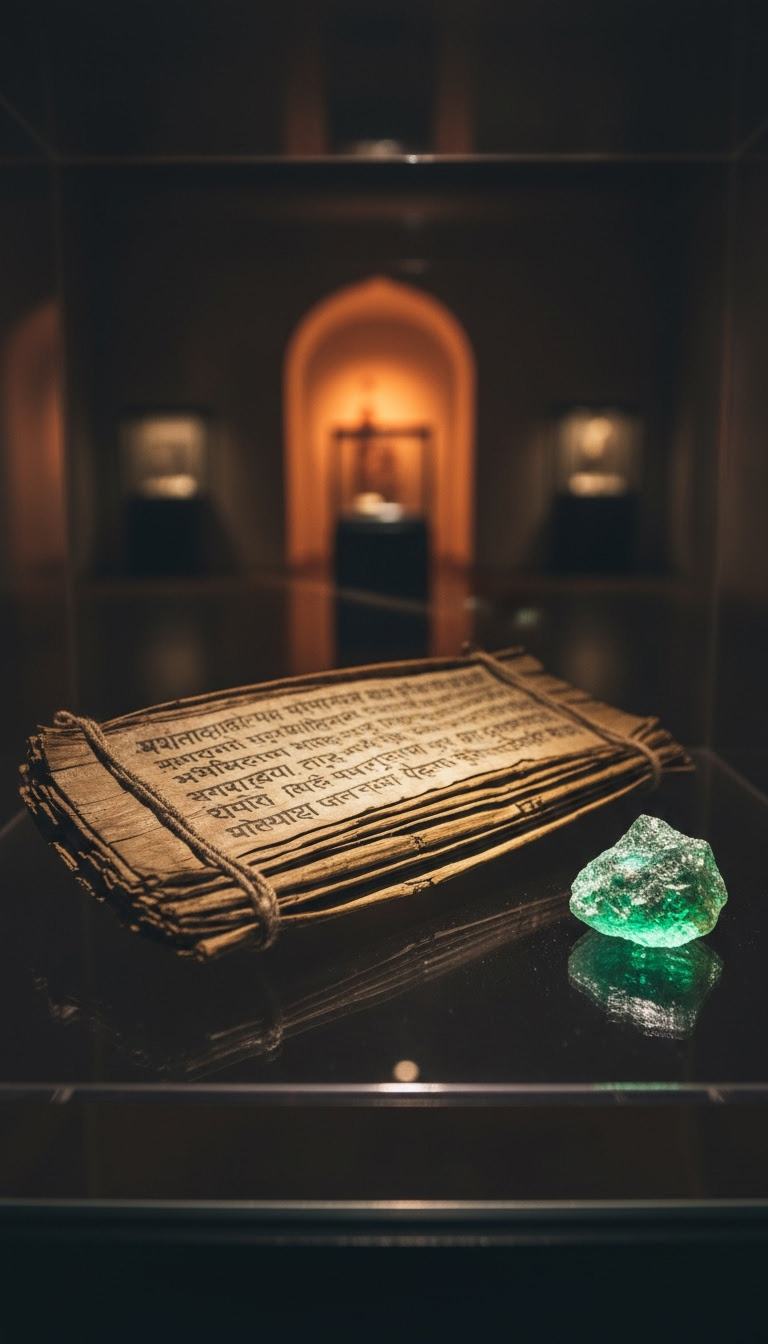
J. Robert Oppenheimer, the physicist who directed the Manhattan Project, quoted the Bhagavad Gita when the first atomic bomb exploded at the Trinity site in New Mexico at 5:29 a.m. on July 16, 1945. The Bhagavad Gita is part of the Mahabharata. The line came to him as the fireball rose. It was verse 11.32: “Now I am become Death, the destroyer of worlds.” He had studied the text in the original Sanskrit at Berkeley. The same epic describes a weapon, the Brahmastra, whose effects read like a field report from Hiroshima.
Read the Mahabharata's battle books beside the 1945 casualty files and the epic stops sounding like myth. It describes a weapon bright as suns, a strike that kills the unborn, and a poison that takes hair and nails. The man who built the bomb had read all of it in a language spoken before Rome existed, years before he ever stood in that desert.
5:29 a.m., Jornada del Muerto, New Mexico
The device the Los Alamos team called the Gadget detonated on a 100-foot steel tower on the Alamogordo Bombing Range at 5:29 a.m. Mountain War Time on July 16, 1945. It released roughly 21 kilotons of energy, the force of 21,000 tons of TNT.
Three receipts survive from that morning. The tower vaporized. The desert sand fused into a green glass the crew named trinitite. Test director Kenneth Bainbridge turned to Oppenheimer and said, “Now we are all sons of bitches.”
Oppenheimer named the site himself. In a 1962 letter to General Leslie Groves, he traced the name to the John Donne Holy Sonnet that opens “Batter my heart, three-person'd God.” A physicist who names a weapons test after a prayer is reading more than physics.
The Verse That Came to Him
Oppenheimer said a line from the Bhagavad Gita rose in his mind as the fireball climbed: “Now I am become Death, the destroyer of worlds.” It is verse 11.32, and the god Krishna speaks it.
The Gita is eighteen chapters of the Mahabharata, set on the battlefield of Kurukshetra. The warrior Arjuna freezes before the slaughter. Krishna is driving Arjuna's chariot. He reveals his universal form and tells Arjuna the destruction is already decided.
Oppenheimer said the line on camera for NBC's 1965 documentary The Decision to Drop the Bomb, eyes down, voice flat. A nearby verse, 11.12, describes the radiance of a thousand suns bursting into the sky at once. The journalist Robert Jungk took that image for the title of his 1956 history of the bomb, Brighter Than a Thousand Suns.
He Learned Sanskrit to Read It
Oppenheimer began studying Sanskrit at the University of California, Berkeley, in 1933 under the scholar Arthur W. Ryder. He read the Gita in the original.
The receipts stack in threes again. He called the Gita “the most beautiful philosophical song existing in any known tongue.” He handed copies to friends. He named his Chrysler Garuda, after the eagle that carries the god Vishnu.
He was a theoretical physicist who would go on to run the most secret weapons program on earth. He also spent his evenings with a war epic more than two thousand years old. He went to the source text the same way he went to the equations.
The man who built the bomb had already read about it, in Sanskrit, twelve years before Trinity.
The Brahmastra and the Strike on the Unborn
The Sauptika Parva of the Mahabharata describes the warrior Ashwatthama firing the Brahmashirsha, a weapon of the Brahmastra class, at the end of the Kurukshetra war. Arjuna fires his own in answer. The sage Vyasa steps between the two fires and orders both men to call them back.
Ashwatthama cannot call his back. He turns it on the wombs of the Pandava women. The unborn heir Parikshit is struck inside his mother Uttara and is born dead until Krishna restores him.
Vyasa adds a detail no fairy tale needs. He warns that any land where this weapon strikes suffers drought for twelve years. That describes a poisoned zone.
The Mausala Parva goes further. An iron bolt wipes out the Vrishni and Andhaka clans. The English rendering most quoted since the 1960s gives the aftermath: a column of smoke and flame as bright as ten thousand suns, hair and nails falling from the survivors, birds turning white, and food turning to poison. We track every celestial weapon the epic names in the lost books.
| Effect | The Mahabharata | 1945 |
|---|---|---|
| The flash | A column of flame bright as ten thousand suns (Mausala Parva) | Trinity's fireball lit the mountains around the Jornada del Muerto before sunrise |
| The unborn | The Brahmashirsha strikes Parikshit in Uttara's womb (Sauptika Parva) | Children exposed in the womb at Hiroshima and Nagasaki were born with severe damage |
| Hair and nails | Survivors lose their hair and nails | Radiation sickness stripped hair from survivors within weeks |
| The land | Twelve years of drought where the weapon strikes | Fallout settled downwind of Trinity across southern New Mexico |
| The witness | Krishna: “I am become Time, the destroyer of worlds” | Oppenheimer: “Now I am become Death, the destroyer of worlds” |
Mohenjo-daro and the Heat-Fused Stones
In 1979 the British-born researcher David Davenport and the Italian writer Ettore Vincenti published 2000 a.C. Distruzione Atomica. They argued that one zone of Mohenjo-daro, the Indus Valley city in Sindh, held heat-fused material, and that the skeletons in its upper layers died in a single event.
Mohenjo-daro stands on the same subcontinent the Mahabharata describes. Its Priest-King bust is held in the National Museum of Pakistan in Karachi. Its bronze Dancing Girl is in the National Museum in New Delhi. The city emptied around 1900 BC, and its builders never returned. The full file sits in our case files.
“In Modern Times”
A story has followed Oppenheimer since the 1960s. A student at the University of Rochester asked him whether Trinity was the first atomic bomb ever detonated. He answered, “Well, yes. In modern times, of course.”
That answer was never filmed. The blast was. Berlyn Brixner, the chief photographer at Trinity, ran dozens of cameras that morning and caught the fireball frame by frame.
Put the three pieces together. He knew the book in its own language. He watched the blast from the control bunker six miles south. And when a student asked about the first atomic test, he answered with a qualifier that left a door open.
Twenty years after Trinity, Oppenheimer described that morning on camera, and he reached for scripture to do it. Krishna's words in the Gita describe a destruction that has already been decided and already witnessed. Oppenheimer read them as a student and lived them as a man.
The epic records the flash, the drought, the dead in the womb and the hair falling out. Trinity reproduced the flash. Within three and a half weeks, Hiroshima and Nagasaki reproduced the rest. The Mahabharata names more than a dozen celestial weapons, and 1945 matched one of them. So who wrote the first account, and what did they watch burn?
Frequently Asked
What did Oppenheimer say when the atomic bomb went off?
He said the Bhagavad Gita's verse 11.32 came to him: “Now I am become Death, the destroyer of worlds.” The Trinity fireball rose at 5:29 a.m. on July 16, 1945, and he repeated the line on camera for NBC in 1965.
Did Oppenheimer actually read Sanskrit?
Yes. He began studying Sanskrit at Berkeley in 1933 under Arthur W. Ryder and read the Bhagavad Gita in the original. He called it the most beautiful philosophical song in any known tongue.
What is the Brahmastra in the Mahabharata?
It is the supreme weapon of the epic. The Sauptika Parva has it striking an unborn child in the womb and leaving twelve years of drought where it lands. The 1945 bombings produced the same pattern: the flash, the poisoned ground, the harm to the unborn.
Did Oppenheimer say Trinity was the first atomic test only in modern times?
That story has followed him since the 1960s. It is set at the University of Rochester, where he answered, “In modern times, of course.” No film of that answer exists, but the Mahabharata's account of the weapon does.
Before you go
7 books the Vatican doesn't want you reading. Free PDF. The texts they cut, with sources. Joined by 300+ Inner Circle members.
No spam. Unsubscribe anytime.
Go deeper
The Hidden Canon, Vol. I: Enoch. Jubilees. Thomas. Mary. Judas. 90 pages, 14 chapters, every receipt cited. The books your Bible quietly removed.
Read the Canon →