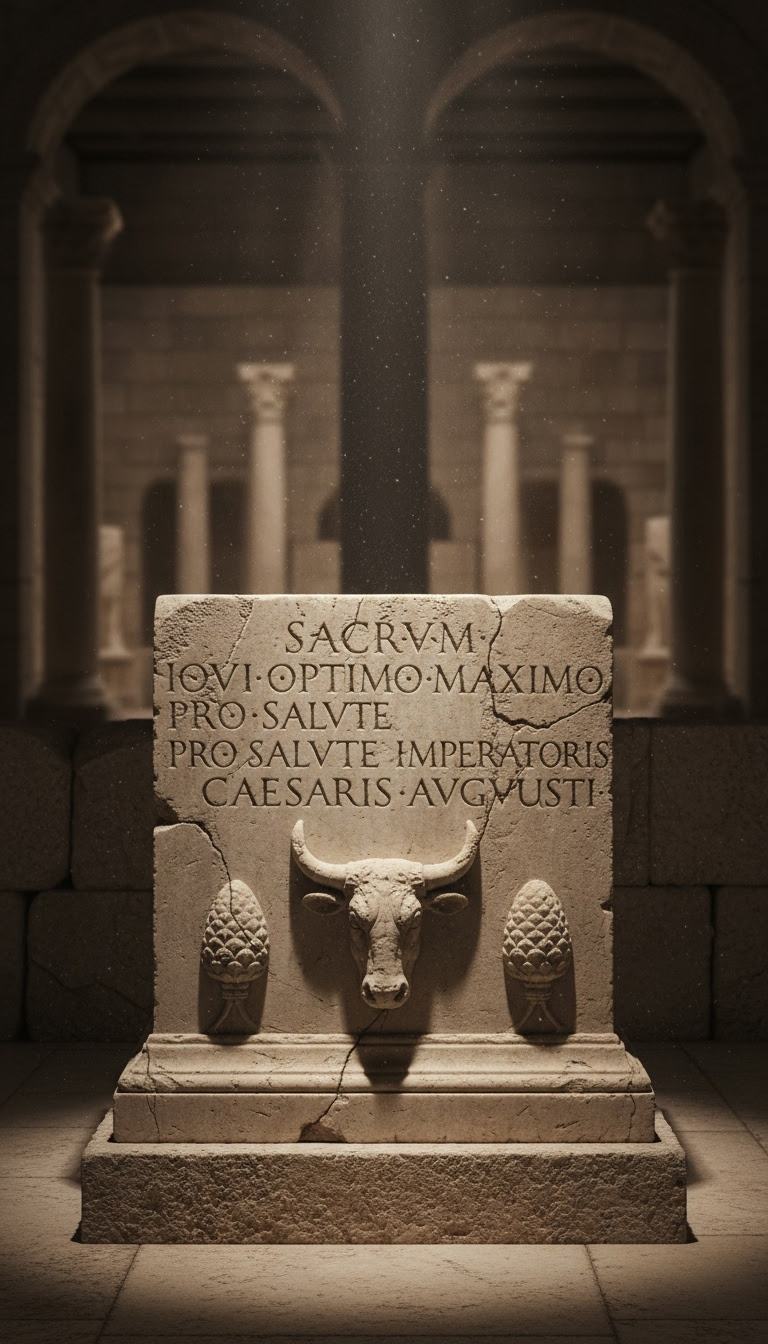
Rome's sanctuary of Cybele and Attis, the Phrygianum, stood on the Vatican Hill, and its blood-rite altars were dug out of the ground in 1609 when workmen opened the foundations for the facade of St Peter's Basilica. Attis was the young god who died under a pine tree. Rome mourned him every March 24, the Day of Blood, and rejoiced on March 25 because he rose. Dated inscriptions on those altars show Roman senators performing the rite there until 390 AD, more than half a century after Constantine's basilica went up on the same hill.
Hold those two facts side by side. A god who died on a tree and rose in spring was worshipped on the Vatican Hill. The mother church of Christianity was built on the Vatican Hill. For two full generations the two shared the slope, and the stones of the older faith ended up buried under the front door of the newer one.
The Phrygianum: The Great Mother on the Vatican Hill
The Phrygianum was the Roman sanctuary of Magna Mater, the Great Mother Cybele, and her consort Attis. Rome brought the goddess from Phrygia in 204 BC as a sacred black stone, during the war with Hannibal, and she never left.
Her Vatican shrine sat in the Ager Vaticanus, beside the Circus of Gaius and Nero, the same circus where Christian tradition places the death of Peter. The fourth-century Regionary Catalogues of Rome list it by name in the Fourteenth Region as the Frigianum. Three receipts, one location: the cult, the catalogue, and the circus next door.
The Day of Blood and the Day of Joy
Every March the city walked through Attis's death and return on a fixed calendar. On March 22, the Arbor Intrat, a pine tree wrapped like a corpse was carried into the sanctuary. That pine was Attis, the god who bled out beneath its branches.
March 24 was the Dies Sanguinis, the Day of Blood. The galli, his priests, lashed themselves until the blood ran and the city mourned a dead god. On March 25 came the Hilaria, the Day of Joy, when the mourning flipped to celebration because Attis lived again.
Death on a tree. A day of grief. A rising in spring. Rome ran this sequence every year on the Vatican Hill long before any basilica stood there.
The Taurobolium: Reborn in a Bull's Blood
The highest rite of the cult was the taurobolium. The initiate went down into a pit covered with a perforated wooden floor. A bull was killed on the planks above, and its blood poured through the holes onto the person below.
The Christian poet Prudentius described it in his Peristephanon, book ten, near 400 AD: the initiate turns his face up into the falling blood, soaks his clothes, opens his mouth to it, then climbs out to be saluted by the crowd as purified. The worshippers called it a rebirth. One Roman altar dedicated in 376 by the senator Sextilius Agesilaus Aedesius says he was "reborn for eternity" through the taurobolium.
"Even the one in the Phrygian cap is a Christian." Augustine of Hippo, quoting a priest of Attis, Tractates on the Gospel of John 7.6
1609: The Altars Under the Facade
In 1609, under Pope Paul V, Carlo Maderno's crews were digging the foundations for the new facade of St Peter's. They struck a cluster of inscribed altars. Every one of them recorded a taurobolium.
The names on them are the Roman senatorial elite of the late fourth century. Petronius Apollodorus in 370. Aedesius in 376. Caelius Hilarianus in 377. The latest dated altar from the site carries the year 390 AD, inside the reign of Theodosius, the emperor who would ban the old rites outright within two years.
Those stones now sit in Rome's collections, catalogued in the sixth volume of the Corpus Inscriptionum Latinarum. Rome dug them out of the basilica's own footprint and kept them. You can read the full chain of texts in our Lost Books archive.
Two Faiths, One Hill
Lay the two calendars over each other and the match is hard to unsee. The early church fixed the date of the crucifixion itself on March 25. Tertullian gives that date in his treatise Against the Jews, around 200 AD, the same day Rome celebrated Attis rising.
| Element | Attis on the Vatican Hill | Christ on the Vatican Hill |
|---|---|---|
| Death | Dies beneath a sacred pine | "Hanged on a tree" (Acts 5:30) |
| Mourning | March 24, Day of Blood | Good Friday |
| Return | March 25, Hilaria, the god lives | Easter; Tertullian dates the Passion to March 25 |
| Initiation | Reborn in the blood of the bull | Washed in the blood of the Lamb (Revelation 7:14) |
| Sanctuary | Phrygianum, Vatican Hill | Basilica of St Peter, Vatican Hill |
The Christians of the period saw it too. Firmicus Maternus, writing to the emperors around 346 AD, raged against the pine-tree rite as the devil's copy of the cross. A copy only needs attacking when the crowd can tell the two apart by nothing but the name.
Augustine went further. He recorded a priest of Attis telling Christians that their god and his were one: "Even the one in the Phrygian cap is a Christian." The pagan clergy were claiming the church as their own, out loud, in the fifth century.
Why Constantine Chose the Hardest Hill in Rome
The church answer is that Constantine built on the Vatican because Peter's grave was there. That answer collapses under the engineering. The site was a sloping hillside packed with a working cemetery, and Constantine's builders had to slice away the hill, fill and bury the tombs, and raise a giant platform to lay his basilica flat. The Lateran, his first church, sat on easy imperial land.
He chose the most expensive ground in Rome, and he chose the slope that already held the Great Mother's blood sanctuary. Builders in the ancient world raised temples on sacred ground because the ground carried the power. Constantine planted his church beside a god of death and spring rising, and the two ran side by side until the altars went into the earth. More sacred sites built on older sanctuaries are mapped in the Vault.
The altars went into the ground in the 390s. The basilica above them was torn down and rebuilt as the St Peter's we know. When Maderno's men dug for the new facade, the old god came back up first, right at the doorstep, with senators' names and consular dates cut into the stone.
So the question stands on the hill itself. Rome mourned a god who died on a tree and rose in spring, on the exact slope where it raised its greatest church. Why that hill? And what else did the foundations swallow that never made it into the catalogue?
Frequently Asked
What was the Phrygianum?
The Phrygianum was Rome's sanctuary of Cybele, the Great Mother, and her consort Attis, on the Vatican Hill beside the Circus of Gaius and Nero. The fourth-century Regionary Catalogues list it by name in Rome's Fourteenth Region.
When did Rome mourn Attis?
Rome mourned Attis on March 24, the Dies Sanguinis or Day of Blood. On March 25, the Hilaria, the mourning turned to joy because the god lived again.
What was found under St Peter's Basilica in 1609?
In 1609, workmen digging the foundations of the St Peter's facade uncovered a group of taurobolium altars from the Phrygianum. Their inscriptions record senators performing the bull-blood rite from the 370s up to 390 AD.
What is a taurobolium?
The taurobolium was the highest rite of the Cybele and Attis cult. A bull was killed on a slatted floor above a pit, and its blood poured down onto the initiate below, who climbed out declared reborn.
Did Attis worship overlap with St Peter's Basilica?
Yes. Constantine's basilica went up on the Vatican Hill in the early fourth century, and the dated altars prove the Attis blood rites ran on the same hill until 390 AD, a span of more than fifty years.
Before you go
7 books the Vatican doesn't want you reading. Free PDF. The texts they cut, with sources. Joined by 300+ Inner Circle members.
No spam. Unsubscribe anytime.
Go deeper
The Hidden Canon, Vol. I: Enoch. Jubilees. Thomas. Mary. Judas. 90 pages, 14 chapters, every receipt cited. The books your Bible quietly removed.
Read the Canon →