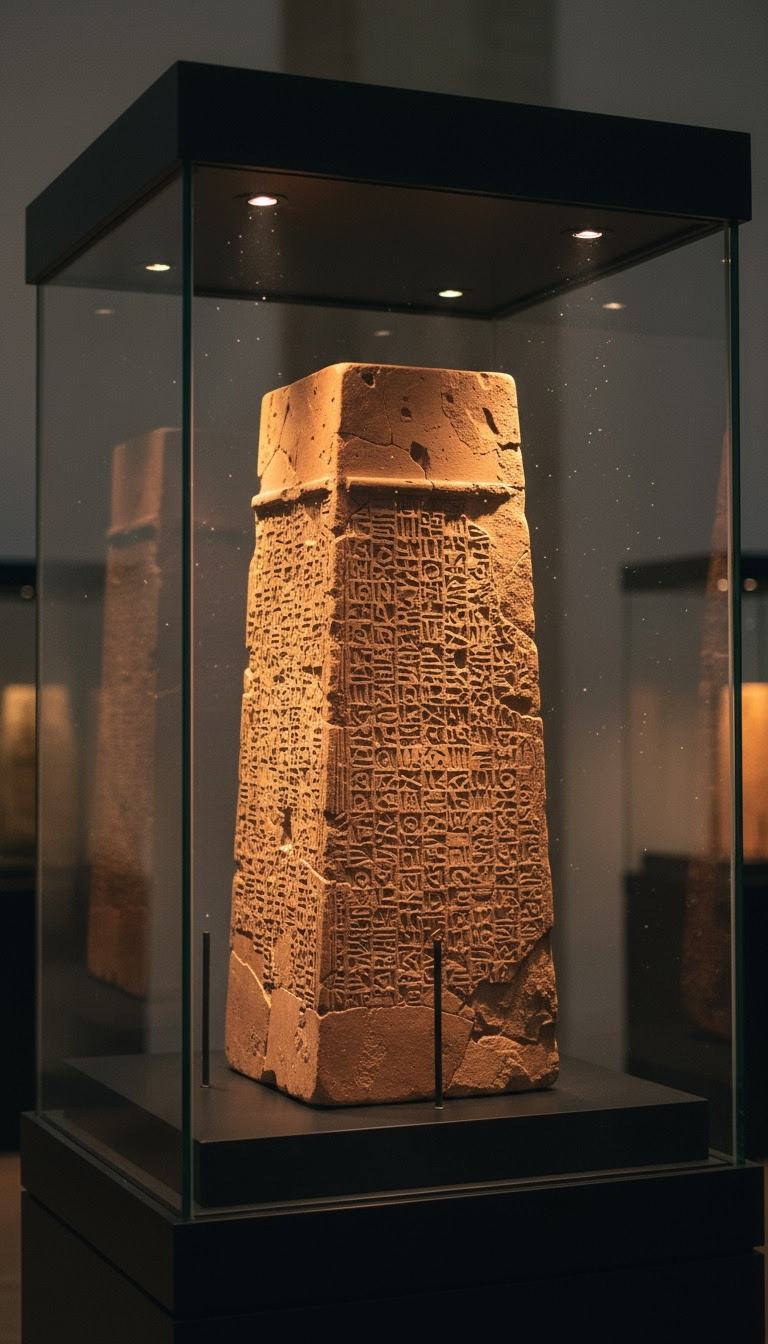
The Sumerian King List records eight kings who ruled Sumer for a combined 241,200 years before the Flood, with single reigns of 28,800, 36,000 and 43,200 years. After the Flood the reigns collapse in stages: 1,200 years for Jushur of Kish, 126 for Gilgamesh of Uruk, and 56 for Sargon of Akkad. The best-preserved copy is the Weld-Blundell Prism in the Ashmolean Museum in Oxford. It marks the break with one line: "Then the Flood swept over."
The scribes put that line there on purpose. Copy after copy kept the same break in the same place, from Nippur to Larsa, for centuries. The kings' lifespans changed on the far side of the water, and the state wrote down the change.
The Prism in Oxford
The Weld-Blundell Prism, catalogued as WB 444, is a four-sided block of baked clay about twenty centimetres tall. Each face carries two columns of dense cuneiform. It is the most complete single copy of the king list known.
Herbert Weld Blundell acquired it in 1922 and gave it to the Ashmolean. Its provenance traces to Larsa in southern Iraq. Stephen Langdon of Oxford published the text in 1923.
A scribe wrote it around 1800 BC, during the dynasty of Isin. The list runs up to his own day, ending with King Sin-magir. This is a working state document, kept current to the reign it was written under.
Oxford holds one copy among many. Fragments of the same list dug out of Nippur sit in the Penn Museum in Philadelphia. Different cities, different hands, the same kings and the same break at the Flood.
Eight Kings, 241,200 Years
The prism opens with the moment kingship came down from heaven. "After the kingship descended from heaven, the kingship was in Eridu." Eridu is the oldest city in southern Mesopotamia, and the list puts the first throne there.
Alulim of Eridu reigned 28,800 years. Alalngar reigned 36,000. En-men-lu-ana of Bad-tibira reigned 43,200, the longest reign the list records.
The kingship then moves through five cities: Eridu, Bad-tibira, Larak, Sippar and Shuruppak. Dumuzi the shepherd gets 36,000 years. En-men-dur-ana of Sippar gets 21,000. Ubara-Tutu of Shuruppak, the last king before the water, gets 18,600.
Add the eight reigns and you get 241,200 years. Then the scribe writes the line that splits the history of the world in two.
| Position on the list | King and city | Reign recorded |
|---|---|---|
| Before the Flood | Alulim of Eridu | 28,800 years |
| Before the Flood | En-men-lu-ana of Bad-tibira | 43,200 years |
| Before the Flood | Ubara-Tutu of Shuruppak | 18,600 years |
| First after the Flood | Jushur of Kish | 1,200 years |
| Early Kish | Etana, "who ascended to heaven" | 1,500 years |
| Uruk | Gilgamesh | 126 years |
| Akkad | Sargon | 56 years |
| Ur III | Shulgi | 48 years |
The Line Where It Breaks
"Then the Flood swept over. After the Flood had swept over, and the kingship had descended from heaven, the kingship was in Kish." Kingship comes down from heaven a second time. The first king of this new world, Jushur, reigns 1,200 years.
The numbers keep falling down the column. Etana the shepherd, "the one who ascended to heaven," gets 1,500. En-me-barage-si of Kish gets 900, and archaeologists found a stone vessel fragment at Khafajah carrying the name "Mebaragesi, king of Kish." A king with a 900-year reign left his name on a real object.
Uruk takes the throne next. Enmerkar reigns 420 years, Lugalbanda 1,200, and Gilgamesh 126. The hero of the oldest epic on earth is a line on a government list, with a reign length attached.
By the time the list reaches Akkad, the reigns look like ours. Sargon gets 56 years. The Gutian rulers who overran Sumer get three years, six years, a handful each. Shulgi of Ur, one of the best-documented kings of the ancient world, gets 48.
The scribes recorded a curve. Tens of thousands of years, then hundreds, then a human lifetime. The Flood sits at the top of the drop.
Why the Number Theory Breaks on the Flood Line
Thorkild Jacobsen of the Oriental Institute in Chicago published the standard edition of the list in 1939. His school reads the early reigns as inflated units: 28,800 is eight sars of 3,600, and 36,000 is ten. In their reading the scribes stacked round sexagesimal numbers to make the ancestors look grand.
Round units explain the shape of a number. They say nothing about where the numbers drop. A scribe padding kings to look grand pads every dynasty, and these scribes stopped at exactly one event and recorded a steady decline after it.
The event also left mud behind. Leonard Woolley cut through roughly eight feet of clean water-laid silt at Ur in 1929. Erich Schmidt found a flood stratum at Shuruppak in 1931, dated to around 2900 BC. Shuruppak is the city of Ubara-Tutu, the last king before the Flood on the prism.
So the list names a city, the Flood falls on that city's king, and the excavators found the flood layer in that city's ground. The scribes were recording a place they knew.
Three Records, One Collapse
Genesis gives the same shape. Ten patriarchs before the Flood, Methuselah living 969 years. After it, Shem lives 600, Arpachshad 438, Abraham 175, Moses 120. Long lives before the water, a falling staircase after it.
Berossus, a priest of Bel at Babylon, wrote his history for the Seleucid court around 280 BC. He lists ten kings before the Flood ruling 120 sars, which is 432,000 years, and names the survivor Xisouthros. Three traditions written in three languages over two thousand years all record the same collapse.
The overlap goes down to individual names. En-men-dur-ana of Sippar, seventh king before the Flood, was taken into the assembly of the gods and taught their secrets. Enoch, seventh from Adam, "walked with God, and he was not, for God took him." The full Enoch tradition, the one the canon cut, is in our Lost Books collection.
Then there is the survivor. A Nippur tablet in the Penn Museum, published by Arno Poebel in 1914, names him Ziusudra, king of Shuruppak. The gods grant him "life like a god" and settle him in Dilmun. The one man who crossed the Flood kept the old lifespan. Every king after him lost it.
Read the prism again with that in mind. Kingship descends from heaven at Eridu. The Flood swept over. Kingship descends from heaven again at Kish. The same thing came down twice, and the second time each king got a fraction of the life the first ones had.
Ziusudra kept his. Etana went up to heaven and came back with 1,500 years. Gilgamesh spent his whole epic hunting the plant that would give the old life back, found it, and lost it to a snake. What exactly did the Flood take from the kings, and why did the one man who survived it get to keep it?
Frequently Asked
What is the Sumerian King List?
It is a royal record from ancient Sumer listing every king, his city and his reign, starting when kingship descended from heaven to Eridu. Its best copy, the Weld-Blundell Prism, is in the Ashmolean Museum in Oxford.
How long did the kings before the Flood reign?
The eight kings before the Flood ruled a combined 241,200 years. Single reigns run from 18,600 to 43,200 years, and Alalngar and Dumuzi each get 36,000.
What happened to reign lengths after the Flood?
They fell in stages. Jushur of Kish ruled 1,200 years, Gilgamesh 126, and Sargon of Akkad 56, which puts the later kings within a normal human lifetime.
Is Gilgamesh on the Sumerian King List?
Yes. He is listed as the fifth king of the First Dynasty of Uruk with a reign of 126 years, on the same state record as kings known from their own inscriptions.
Does the Bible record the same lifespan drop?
Genesis records ten long-lived patriarchs before the Flood, with Methuselah reaching 969, then a falling staircase after it down to Abraham at 175 and Moses at 120. Berossus of Babylon records the same before-and-after split.
Before you go
7 books the Vatican doesn't want you reading. Free PDF. The texts they cut, with sources. Joined by 300+ Inner Circle members.
No spam. Unsubscribe anytime.
Go deeper
The Hidden Canon, Vol. I: Enoch. Jubilees. Thomas. Mary. Judas. 90 pages, 14 chapters, every receipt cited. The books your Bible quietly removed.
Read the Canon →