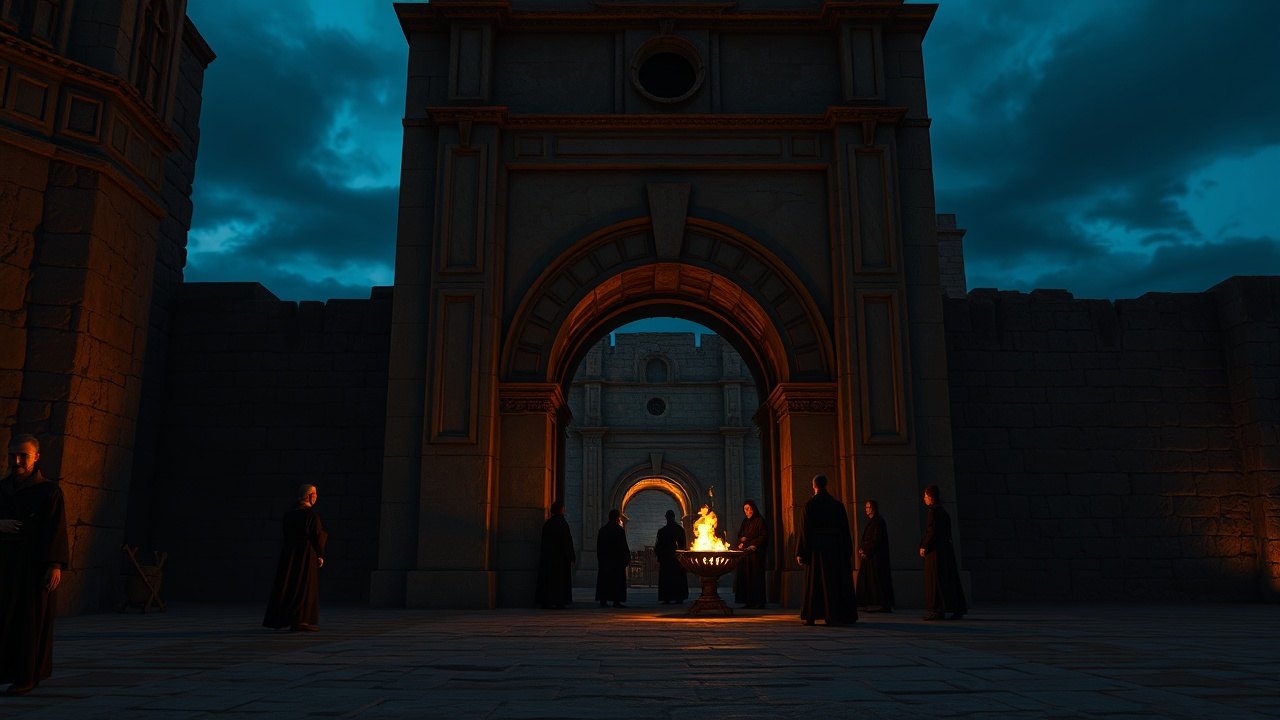
Around the year 593 BCE, a Hebrew priest named Ezekiel, exiled in Babylon, recorded a vision of the Jerusalem Temple. He was carried in spirit to the north gate of the inner court of the house of the Lord. What he saw, he reported in eight Hebrew words.
"Behold, there sat women weeping for Tammuz."
The verse is Ezekiel 8:14. The Hebrew name is תַּמּוּז. Tammuz is not a Hebrew god. He is the Sumerian shepherd-deity Dumuzid, consort of Inanna, killed and descended into the underworld and returned in the spring. His earliest hymns were already over a thousand years old when Ezekiel saw the women mourning him at the gate of the Yahweh's own house.
The Bible documented a pagan dying-and-rising god cult operating inside the holiest building in Israel. Six centuries before the resurrection of Jesus.
The Verse That Most Christians Have Never Read
Ezekiel 8 is a single sustained vision. The prophet is shown a sequence of four "abominations" being practiced inside the Temple precinct. Each is worse than the last. The Tammuz weeping is the third.
The King James rendering: "Then he brought me to the door of the gate of the LORD's house which was toward the north; and, behold, there sat women weeping for Tammuz."
The text does not present this as a foreign novelty. Ezekiel does not say the women were Babylonian visitors, or that the rite had just arrived. He places them at the north gate of the inner court of the Temple in Jerusalem, and the grammar treats their mourning as a settled practice. The verb tense in the Hebrew is the participle mevakkot, "weeping," continuous action. They were already there. They were already doing it. The prophet's complaint is not that something new had appeared. It is that it had been there long enough that he was being shown it as proof of how deep the corruption had reached.
This is the smoking gun, and it is sitting in a canonical book of the Hebrew Bible.
Who Tammuz Actually Was
Tammuz is the late West Semitic form of the Sumerian name Dumuzid, sometimes Dumuzi, "the faithful son." He was a shepherd-king, the divine consort of the goddess Inanna, known to the Akkadians and Babylonians as Ishtar. The earliest references to Dumuzid appear in the Sumerian King List and in temple hymns dating to the Early Dynastic III period, roughly 2600 to 2334 BCE. The cycle of his death and return is documented in the Sumerian poem Inanna's Descent to the Underworld, surviving in Old Babylonian copies from around 1900 BCE that copy older originals.
The narrative arc is consistent across Sumerian, Akkadian, and later Babylonian sources. Inanna descends to the underworld and is killed. She is revived by the gods on the condition that someone take her place. She returns to the surface and finds Dumuzid not mourning her. In retaliation she condemns him to the underworld in her stead. His sister Geshtinanna agrees to share the sentence. The two of them rotate: half the year Dumuzid is dead in the underworld, half the year he returns to the surface and Geshtinanna takes his place.
His annual death falls in midsummer, when the Mesopotamian heat scorched the pastures and the shepherd's world withered. His return came in spring, when the rains revived the land. The lamentation literature surrounding him includes the Lamentation Over the Ruin of Ur, composed around 1940 BCE, which references him as part of the older religious furniture of southern Mesopotamia. By the Babylonian period the rites had hardened into an annual cycle of public mourning followed by celebration of his return.
Three days of mourning. Resurrection in spring. The fertility of the land tied to the body of the god. The pattern is not subtle. It is not buried. It is the dominant theological structure of two and a half millennia of Mesopotamian religion before any prophet of Israel wrote a word.
"Tammuz died and rose every year for 2,500 years before Jesus did it once. The Bible names him. The Bible places him inside the Temple. The Bible documents the women who wept for him. The receipt is in the canon."
How the Cult Reached Jerusalem
The path is not mysterious. Sumer to Akkad to Babylon to the Levant is the same trade and conquest corridor that produced the Hebrew patriarchal narratives, the Tower of Babel, the flood account, the Babylonian exile itself. Mesopotamian religion was the gravitational center of the ancient Near East, and Israel sat on its periphery.
By the time Ezekiel was writing, the Tammuz cult had been moving westward for over a millennium. The Phoenicians knew him as Adonis, from the Semitic root adon, "lord." The Greeks adopted the Phoenician form. Sappho of Lesbos, writing in the early sixth century BCE, includes a fragment of an Adonis-mourning lament that scholars place in continuity with the older Mesopotamian rites. The cult reached Greece by at least the seventh century. By the Hellenistic period it was a fixture of the eastern Mediterranean religious landscape.
The Hebrew kingdom did not have a wall around it. Tyre and Sidon were a few days' journey north. Damascus was a regional capital. Babylonian merchants and Phoenician artisans worked in Jerusalem. The Hebrew women weeping at the north gate were participating in a rite that had already been adopted across the ancient world's most cosmopolitan cultures. They were not deviants in their cultural moment. They were typical.
The Calendar Still Carries His Name
The strongest single piece of evidence for how deeply the cult penetrated Hebrew religion is not in any prophetic book. It is in the calendar that Orthodox and Conservative Jews still use today.
The fourth month of the Hebrew civil year, falling roughly in June and July, is called Tammuz. The name was adopted during the Babylonian exile, in the very period Ezekiel was writing. It was never removed. It is the month of the summer solstice, the period when the Mesopotamian Tammuz was understood to have died and descended.
Within that month, the Hebrew calendar preserves a fast: Shiva Asar B'Tammuz, the Fast of the Seventeenth of Tammuz. It marks, in mainstream Jewish tradition, the breaching of the walls of Jerusalem before the Temple's destruction. But the fast opens a three-week mourning period that runs through Tisha B'Av, the ninth of Av, the date of the Temple's destruction. The structure is a three-week summer mourning period beginning in the month named after the dying shepherd-god.
The rabbinic tradition reframed the mourning around the loss of the Temple. The structural skeleton, a summer fast, a three-week lamentation, anchored in the month of Tammuz, is the same skeleton the Babylonians used to mourn Dumuzid. Reframed, retained, and never renamed.
The Cuneiform That Survived
The texts the Hebrew exiles would have encountered are not lost. They were excavated from the Library of Ashurbanipal at Nineveh in the 1850s, where Hormuzd Rassam and Austen Henry Layard pulled some thirty thousand cuneiform tablets out of the ruins of the Assyrian palace. The library was assembled in the seventh century BCE, before Ezekiel was born, and it preserved Sumerian and Akkadian religious literature already centuries old when the scribes copied it.
Among the tablets are multiple versions of the Tammuz lamentations. British Museum tablet K.4954 and related pieces preserve Akkadian compositions in which Ishtar mourns Tammuz with the language of widow-grief, calling him "the shepherd, the lord," demanding his return. The lamentation cycle is liturgical. It was sung. It was performed. The texts are stage directions for the rite that the women at Ezekiel's north gate were enacting in Jerusalem.
These are not late-period reconstructions. The cuneiform predates Ezekiel, predates the exile, predates Solomon's Temple. The religion he was condemning was older than the building it had infiltrated.
The Church Fathers Knew
The patristic record on Tammuz is unusually clear, because the cult survived into the Christian period and the early bishops had to address it directly.
Origen, writing around 240 CE in his Selecta in Ezechielem, comments on the Ezekiel passage and identifies Tammuz with Adonis. He notes the annual mourning rite and treats the identification as established. This is one of the earliest Christian scholarly engagements with the verse, and it does not argue the parallel. It assumes it.
Jerome, writing his Latin Vulgate commentary on Ezekiel around 400 CE, repeats and extends the identification. He notes that the Adonis cult was still being practiced in Bethlehem in his own time, that a sacred grove of Adonis stood near the supposed birthplace of Christ, and that the parallels between the Adonis mourning rites and the Christian Holy Week observances were obvious to anyone with eyes. Jerome was no skeptic. He was the most influential biblical translator in Western Christianity. He recorded the parallel and did not attempt to suppress it.
Most damning of all, the Council of Laodicea, convened around 364 CE, issued canons regulating Christian practice. Among its prohibitions was an explicit ban on Christians participating in mourning rites for pagan gods. Later medieval commentators recorded that the "weeping for Tammuz" survived in nominal Christian communities and had to be repeatedly suppressed. The council fathers were not legislating against a dead tradition. They were trying to stop a living one from contaminating their congregations.
The cult inside the Temple in 593 BCE was still walking around inside the Church a thousand years later.