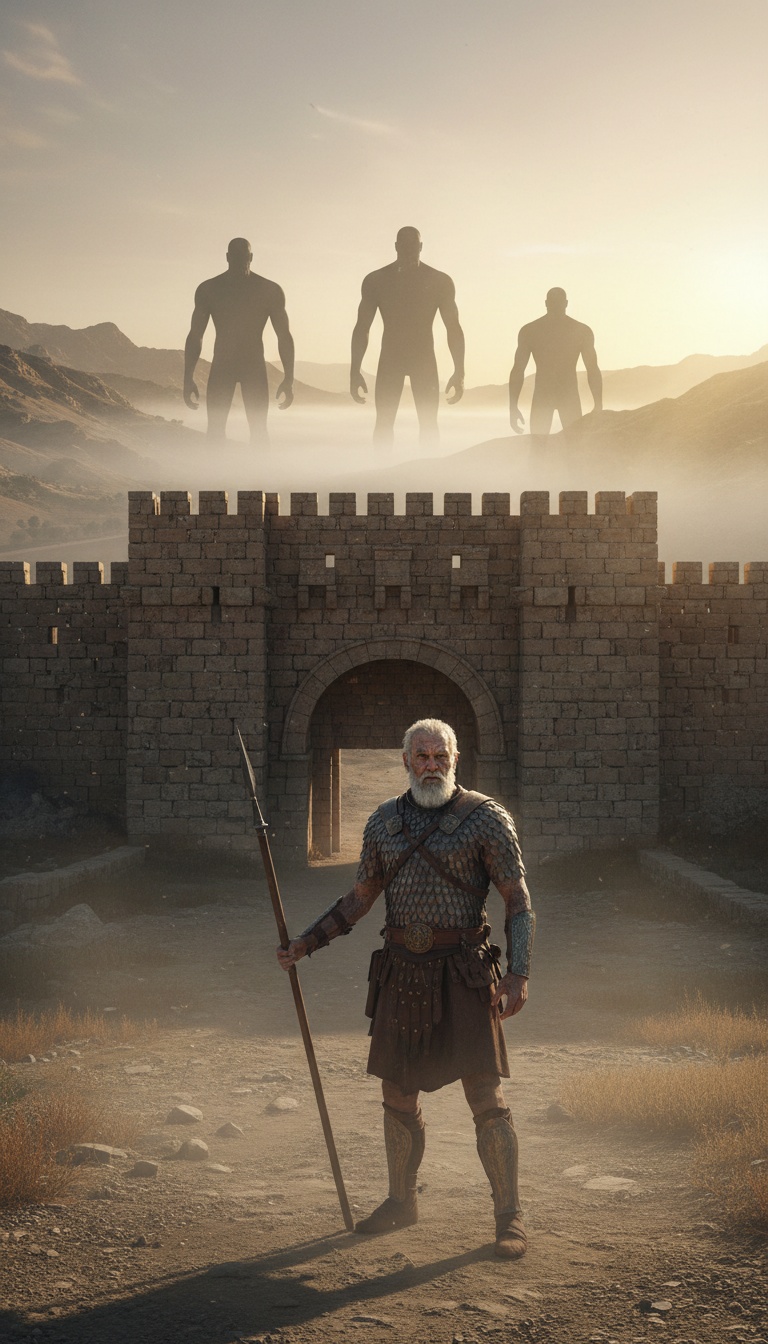
David killed one giant and became the most famous name in the Hebrew Bible. An 85-year-old cleared a whole city of them and got a single chapter buried in Joshua.
His name is Caleb. The text names the giants he killed. And almost nobody teaches it.
The Grasshopper Report
Forty-five years before Caleb walked up that mountain, twelve spies crossed into Canaan on a scouting mission ordered by Moses. Numbers 13 lists them by tribe. Caleb, son of Jephunneh, represented Judah. Joshua, son of Nun, represented Ephraim.
Ten of the twelve came back terrified. They had seen the Anakim in the hill country around Hebron. Their report, preserved in Numbers 13:33, includes the line that broke the nation. "We were in our own sight as grasshoppers, and so we were in their sight."
Only two spies voted to attack anyway. Caleb and Joshua. The other ten spread panic through the camp, and Israel voted to turn around. That vote cost them forty years in the wilderness and an entire generation.
The Promise Moses Made
Because Caleb refused to break with the minority report, Moses made him a specific promise. Deuteronomy 1:36 records it. The land Caleb's feet had walked on would belong to him and his descendants.
That land was Hebron. The exact hill country the Anakim still occupied. The exact place ten grown men had refused to attack.
Caleb spent the next forty-five years watching his generation die off in the desert. Then he crossed the Jordan with Joshua, fought through the conquest campaigns, and waited while the tribes drew lots for territory. He never once collected on the promise.
Give Me This Mountain
Joshua 14 opens on the land division at Gilgal. Caleb walks up to Joshua, who by now is running the country, and calls in the debt. The speech is preserved in Joshua 14:10-12.
He states his age. Eighty-five. He states his condition. "I am as strong this day as I was in the day that Moses sent me. As my strength was then, even so is my strength now, for war, both to go out and to come in."
Then he names the target. "Now therefore give me this mountain, whereof the LORD spake in that day. For thou heardest in that day how the Anakims were there, and that the cities were great and fenced. If so be the LORD will be with me, then I shall be able to drive them out, as the LORD said."
He was 85 years old. He asked for the one piece of land no one else would touch. And Joshua gave it to him.
The Three Names in Joshua 15
Most sermons on Caleb stop at the speech. The actual killing is in the next chapter, and it is specific.
Joshua 15:14 lists the dead by name. "And Caleb drove thence the three sons of Anak, Sheshai, and Ahiman, and Talmai, the children of Anak."
Sheshai. Ahiman. Talmai. Three named Anakim warlords, driven out of Hebron by an octogenarian from Judah. The parallel account in Judges 1:10 confirms it and adds that Hebron was formerly called Kirjath-arba, the city of Arba, who Joshua 14:15 calls "a great man among the Anakims."
Who the Anakim Actually Were
The Anakim are not a rhetorical flourish. Numbers 13:22 places them in Hebron alongside three named clans. Deuteronomy 2:10-11 groups them with the Rephaim, the same category as Og of Bashan, whose iron bedstead is measured in Deuteronomy 3:11 at nine cubits by four.
Deuteronomy 9:2 describes them as "a people great and tall, the children of the Anakims, whom thou knowest, and of whom thou hast heard say, Who can stand before the children of Anak?"
The text treats them as a known military problem. A category of enemy that terrifies professional armies. And Caleb walked into their capital at 85 and cleared it by name.
Why the Story Gets Buried
David killed one giant, Goliath, in 1 Samuel 17. That fight got a full chapter, a taunt speech, five smooth stones, and roughly three thousand years of sermons, paintings, and children's books.
Caleb cleared an entire fortified city of Anakim and got most of one chapter, Joshua 14, plus a two-verse mop-up in Joshua 15. No taunt. No monologue. No slingshot. Just an old man collecting a forty-five-year-old IOU.
The Calebites, his descendants, later show up in 1 Chronicles 2 and Samuel as a distinct clan in southern Judah and the Negev. His daughter Achsah gets her own land negotiation in Joshua 15:16-19, where she demands upper and lower springs from her father and gets them. The family did not shrink after Hebron.
Ten spies looked at the Anakim and saw grasshoppers in the mirror. Caleb looked at the same giants, waited forty-five years in a desert, and walked up the mountain at 85 to collect what he was promised.
The Bible names the men he killed. Sheshai. Ahiman. Talmai. The sons of Anak, driven out of Hebron by an old man from Judah. So why is David the household name and Caleb the footnote? Who decided which giant-killer got the marketing budget?
Before you go
7 books the Vatican doesn't want you reading. Free PDF, the texts they cut, with sources. Joined by 140+ Inner Circle members.
No spam. Unsubscribe anytime.
Go deeper
The Hidden Canon, Vol. I, Enoch. Jubilees. Thomas. Mary. Judas. 90 pages, 14 chapters, every receipt cited. The books your Bible quietly removed.
Read the Canon →Books that informed this investigation
As an Amazon Associate, Hidden Epoch earns from qualifying purchases. Cost to you: nothing.
Research safely
The VPN we use to research without being tracked. First 3 months free.
Get NordVPN →