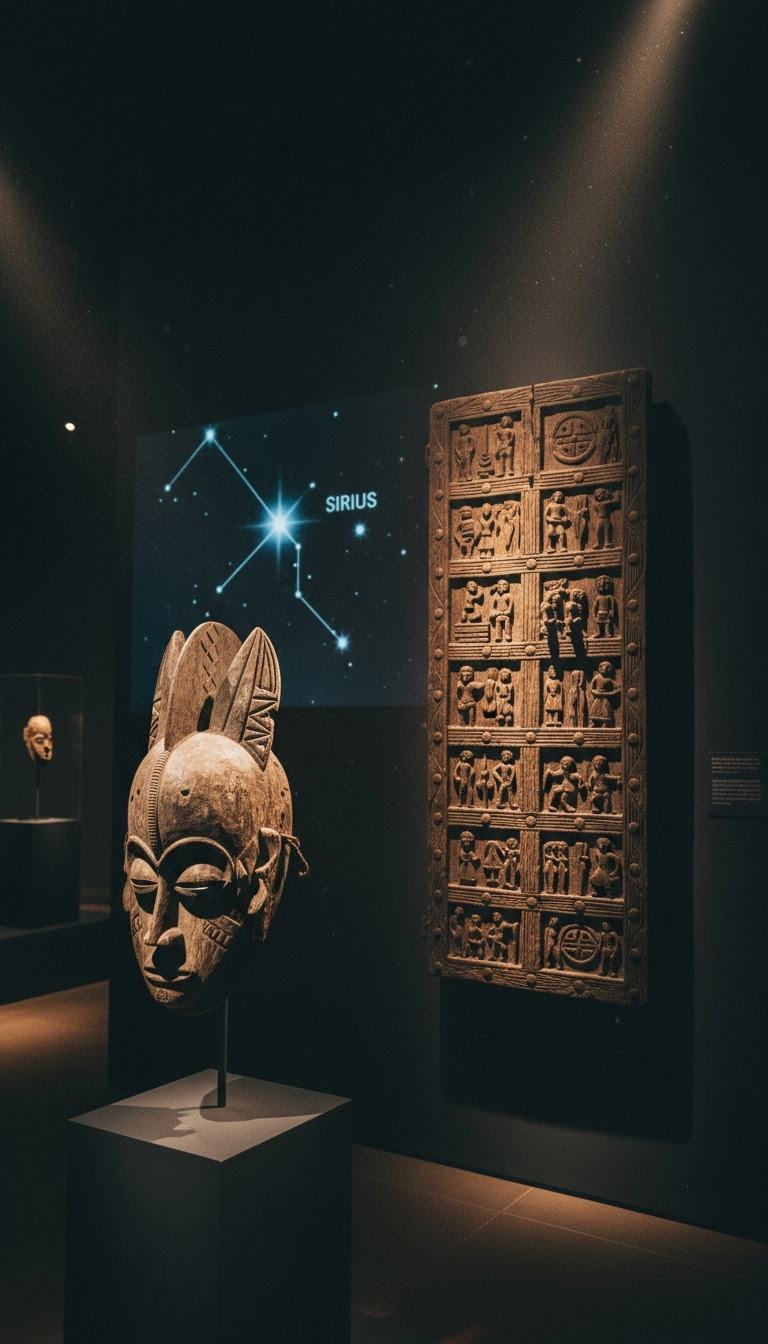
The Dogon people of Mali described Sirius B, a star invisible to the naked eye, to the French anthropologists Marcel Griaule and Germaine Dieterlen, who published the account in 1950. The Dogon said the bright star Sirius has a tiny companion that circles it every fifty years and is made of a substance so heavy that all the men on Earth together could not lift it. Sirius B orbits Sirius A every 50.1 years, and it is a white dwarf so dense that a teaspoon of its matter would weigh several tons on Earth.
The star itself is only half of the mystery. When the Dogon were asked who gave them this knowledge, they named their teachers: the Nommo, amphibious beings who came down from the Sirius system in a vessel of fire and wind. Four thousand miles away, the oldest records of Mesopotamia describe the same visitor.
The Cliff Village and the Twenty-Year Interview
The Dogon live along the Bandiagara Escarpment in central Mali, a sandstone cliff that runs for about 150 kilometers above the Seno plain. Their villages cling to the rock face, with granaries tucked into ledges and older cliff dwellings left by the Tellem people above them. In the 1930s the nearest observatory was a continent away.
Marcel Griaule first reached the Dogon in 1931 with the Dakar-Djibouti Mission, a French expedition that crossed Africa from the Atlantic to the Red Sea. Hundreds of Dogon objects collected on that journey now sit in the Musée du quai Branly in Paris. Griaule kept coming back for more than two decades, and Germaine Dieterlen joined the fieldwork later in the decade and worked beside him until his death in 1956.
Griaule earned what outsiders almost never earn: initiation into the deep knowledge. In 1946 a blind elder named Ogotemmêli spent thirty-three days explaining the Dogon cosmology to him, an account Griaule published in 1948 as Dieu d'eau. In 1950 Griaule and Dieterlen published the Sirius material itself in the Journal de la Société des Africanistes under the title "Un système soudanais de Sirius." Their sources were four senior Dogon priests.
What the Elders Said About Po Tolo
The Dogon call the companion star po tolo. The po is the fonio grain, Digitaria exilis, the smallest seed the Dogon cultivate. They named the star after the tiniest thing they knew because they described it as tiny.
They called it the heaviest star in the sky. The priests said it is made of a metal called sagala, brighter than iron and so heavy that all the beings of Earth combined could not raise a single piece of it. That is a direct description of degenerate matter.
They gave it a fifty-year orbit around Sirius. They drew that orbit for Griaule and Dieterlen as an elongated oval, with Sirius placed away from the center. Every one of those details matches the white dwarf astronomers know today.
| Detail | Dogon account (Griaule and Dieterlen, 1950) | Modern astronomy |
|---|---|---|
| Existence | Sirius has a hidden companion, po tolo | Sirius B, invisible to the naked eye |
| Size | Named after the smallest seed | Roughly the diameter of Earth, a stellar dwarf |
| Weight | Made of sagala, a metal no one can lift | A teaspoon weighs several tons |
| Orbit | Circles Sirius every fifty years | Orbital period of 50.1 years |
| Orbit shape | An oval, Sirius off-center | Elliptical, Sirius A at one focus |
The Dates Break the Traveler Theory
The companion took Western science eighty years to find. Friedrich Bessel predicted it in 1844 from a wobble in Sirius's path. Alvan Graham Clark first saw it on January 31, 1862, while testing an 18.5-inch lens at his father's workshop in Cambridgeport, Massachusetts.
The density came much later. Walter Adams took the spectrum of Sirius B at Mount Wilson Observatory in 1915, and Arthur Eddington worked out what it meant in The Internal Constitution of the Stars in 1926. Matter crushed beyond anything on Earth became a scientific idea only five years before Griaule arrived on the cliffs.
Carl Sagan argued in Broca's Brain in 1979 that a Western visitor carried the information in. Follow that theory to its end. A traveler reaches a cliff village in the Sahel between 1926 and 1931, carrying the newest astrophysics on the planet, and explains Eddington's degenerate matter in a language with no word for a star's mass. Then the priests weave it into their most sacred ceremony and swear to a French ethnographer that it is ancient. The timeline collapses under its own weight, the way sagala would.
The Dogon named the star after the smallest seed they owned and called it the heaviest thing in the sky. Western science needed eighty years and three observatories to say the same sentence.
A Ceremony Older Than the Telescope
The Dogon mark the cycle of po tolo with the Sigui, a ceremony held once every sixty years. It moves from village to village across the escarpment over seven years. The last Sigui began in 1967 at Youga Dogorou and ended in 1973.
For each Sigui the Dogon carve a new Great Mask, the imina na, and keep the old ones in sheltered caves. In his 1938 study Masques dogons, Griaule described a sequence of these masks in a shelter at Ibi that pushes the ceremony back centuries. A knowledge system measured in sixty-year cycles cannot be invented in a single generation.
That is the trap for the traveler theory. The Sirius knowledge sits inside the oldest ritual clock the Dogon own. You can read more ritual calendars like it in our Vault.
Nommo and Oannes: Two Peoples, One Visitor
The Dogon say the Nommo descended from the Sirius system in an ark that came down spinning, with a roar of wind and fire. The Nommo were amphibious, more at home in water than on land. They taught the first humans speech, order and the sky.
Around 290 BC, a Babylonian priest named Berossus wrote the Babyloniaca, a history of Mesopotamia for the Greek king Antiochus I. He recorded that a being named Oannes rose from the Erythraean Sea with the body of a fish and the head of a man. Oannes came ashore each day to teach mankind writing, mathematics, building and law, and returned to the water every night.
The Assyrians carved these teachers in stone. The fish-cloaked apkallu sages from Nimrud stand today in the British Museum in London, scaled garments draped from head to heel. Two peoples separated by the Sahara describe an amphibious teacher who brought civilization from somewhere else. We track the texts behind Oannes in our Lost Books collection.
The Dogon knew the size of the star, its weight and the length of its orbit, and they gave the credit to beings from that same star. Berossus wrote down the same teacher two thousand years earlier, rising from the sea with the gift of knowledge. Every receipt in this case points back to one source.
The Dogon count sixty years between Sigui ceremonies, which puts the next one around 2027. The priests said the Nommo will return. If the elders were right about the invisible star, what else did they tell Griaule that nobody has checked yet?
Frequently Asked
What did the Dogon know about Sirius B?
The Dogon told Marcel Griaule and Germaine Dieterlen that Sirius has a tiny companion star, po tolo, that orbits it every fifty years and is made of the heaviest matter in existence. Sirius B is a white dwarf with a 50.1-year orbit and matter so dense a teaspoon weighs tons.
Can you see Sirius B with the naked eye?
No. Sirius B is drowned out by Sirius A, the brightest star in the night sky, and Alvan Graham Clark first saw it in 1862 through an 18.5-inch telescope lens.
Who are the Nommo?
The Nommo are the amphibious beings the Dogon name as their teachers. They came down from the Sirius system in a spinning vessel of fire and wind and gave the first humans speech, order and knowledge of the sky.
Could a Western traveler have taught the Dogon about Sirius B?
The density of Sirius B was worked out by Arthur Eddington only in 1926, five years before Griaule arrived. A traveler would have to deliver brand-new astrophysics to a cliff village and the priests would have to fold it into a sixty-year ceremony as if it had always been there.
How is Oannes connected to the Dogon?
Oannes is the fish-bodied teacher the Babylonian priest Berossus described around 290 BC, rising from the sea to give mankind writing and law. The Dogon Nommo are amphibious teachers with the same role, which puts one visitor in two ancient traditions four thousand miles apart.
Before you go
7 books the Vatican doesn't want you reading. Free PDF. The texts they cut, with sources. Joined by 300+ Inner Circle members.
No spam. Unsubscribe anytime.
Go deeper
The Hidden Canon, Vol. I: Enoch. Jubilees. Thomas. Mary. Judas. 90 pages, 14 chapters, every receipt cited. The books your Bible quietly removed.
Read the Canon →